Monday, March 7, 2022

‘Delia’s Gone . . .’

by whiteray

Delia, oh, Delia
Delia all my life
If I hadn't shot poor Delia
I'd have had her for my wife
Delia’s gone, one more round
Delia’s gone
 

So sang Johnny Cash on his 1993 album American Recordings. But who was Delia? 

Well, she was a real person. Her name was Delia Green. Here’s part of what Wikipedia has to say about her: 

Delia Green (1886 – December 25, 1900) was a 14-year-old African-American murder victim who has been identified as the likely inspiration for several well-known traditional American songs, usually known by the titles “Delia” and “Delia’s Gone.” 

According to contemporaneous reports published in Georgia newspapers, Green was shot by 15-year-old Mose (or Moses) Houston late on Christmas Eve, 1900, in the Yamacraw neighborhood of Savannah, Georgia, and died at 3:00 a.m. on Christmas Day. Houston, the newspapers implied, had been involved in a sexual relationship with Green for several months. The shooting took place at the home of Willie West, who chased down Houston after the shooting and turned him over to the city police. 

Green’s murder and Houston’s trial in the spring of 1901 were reported in the Savannah Morning News and the Savannah Evening Press. Although Houston reportedly had confessed to the murder at the time of his arrest, at his trial he claimed the shooting was accidental. Other witnesses, however, testified that Houston had become angry after Green called him “a son of a bitch.” 

Wikipedia notes that Green was buried in an unmarked grave in Laurel Grove Cemetery South in Savannah. Someone, in recent years, has installed a memorial stone for her at Laurel Grove:

As to the music that’s kept her memory alive, the earliest version of any of the songs inspired by Green’s fate listed at Second Hand Songs is “Delhia,” a 1939 Decca recording by Jimmie Gordon and His Vip Vop Band. From that point, the list of recordings has a gap covering the entire 1940s, with recording picking up in the 1950s. After that, versions of the songs “Delia” and “Delia’s Gone” (sometimes as “Delia Gone”) came from, among many others, Josh White, Pete Seeger, Harry Belafonte, Acker Bilk, Pat Boone, Bobby Short, Burl Ives, Glenn Yarbrough, and Pat Green & Cory Morrow. 

Second Hand Songs notes: 

There are reputedly recordings of “Delia” going back to the 1920s. It was collected in print form not later than 1927, and possibly earlier. Versions have been recorded as, among others, “Little Delia,” “Deliah” and “Delia’s Gone.” The latter title apparently originated in the Bahamas when the song – with substantially different lyrics – migrated there. As early as 1935, Alan Lomax recorded a local version by The Nassau String Band. In 1959, Karl Silbersdorf and Dick Toops made a questionable copyright with the same title, used by Johnny Cash in 1962 and many to follow. 

The mention of “substantially different lyrics” echoes a comment about the songs and their titles found at Wikipedia: “The songs inspired by Green’s murder now appear in two forms; both forms were staples of the ‘folk revival’ of the 1950s and early 1960s. One version, usually attributed to Blake Alphonso Higgs [better known as Blind Blake], is known as ‘Delia’s Gone.’ It is explicitly told from her killer’s point of view. The second version, usually attributed to Blind Willie McTell, is usually known as ‘Delia’ and is told from the point of view of a loved one of Delia’s. 

Trying to make all the information and suppositions in all of that square up in a nice pile is difficult (and might be impossible even with further research), but that’s often the way it goes with folk songs. 

Both of Cash’s recordings were of “Delia’s Gone,” told from the point of view of the killer (as could be inferred from the verse at the top of this piece). The 1962 version referenced by Second Hand Songs was released on the album The Sound Of Johnny Cash. Thirty-two years later, in 1993, he re-recorded the song for the above-mentioned album American Recordings. Here’s how he told the tale the second time: 

Delia, oh, Delia
Delia all my life
If I hadn't shot poor Delia
I'd have had her for my wife
Delia’s gone, one more round
Delia’s gone
 

I went up to Memphis
And I met Delia there
Found her in her parlor
And I tied her to her chair
Delia’s gone, one more round
Delia’s gone
 

She was low-down and trifling
And she was cold and mean
Kind of evil make me want to
Grab my sub-machine
Delia’s gone, one more round
Delia’s gone
 

First time I shot her
I shot her in the side
Hard to watch her suffer
But with the second shot she died
Delia’s gone, one more round
Delia’s gone
 

But jailer, oh, jailer
Jailer, I can’t sleep
’Cause all around my bedside
I hear the patter of Delia’s feet
Delia’s gone, one more round
Delia’s gone
 

So if your woman's devilish
You can let her run
Or you can bring her down and do her
Like Delia got done
Delia’s gone, one more round
Delia’s gone

Delia’s gone, one more round
Delia’s gone

Sunday, March 6, 2022

Sundries

Good Things about wearing glasses: you can take them off and not be able to see things you don't want to see. This is handy in various situations, such as speaking to a large group of people, or being in a place where you don't feel comfortable making eye contact. Maybe you just want to feel fog or mist in your eyes, or you want all the scenery to look more like a water color, diffused greens. When you take off your glasses you can be more alone with yourself. Being able to do that is nice, perhaps even making up for having to set things on your nose every day, and not being able to have a stash of cheap fantastic sunglasses. 
I'll be 64 in 8 days and I know what I want. To not have to talk. To observe, to think, to scribble. Heaven.
As it is I must talk to 2nd graders, which can be a lovingly enjoyable thing or exasperating. And I'll have to talk in meetings, nauseating. I will need to have the necessary conversations for conducting transactions, and sharing the day with loved ones, but oh, how I'd love a vow of silence.

We all know the world has entered an era we cannot escape. No normal, waiting in the wings. Truths will come out.  Roleplayers behind the scenes will be revealed. I'm sorry that we are finding out that we are members of a species that found it desirable to screw the planet and everyone on it for power and money. I'm sorry for how much suffering is coming our way. I'm sorry because it may not be fair; maybe you and I are not to blame. But here we are. 
 Solutions to the immediate troubles are in the moment, as always, so choose the most helpful responses as i know you will, show the goodheartedness you possess, as i know you will, and if you are called to play a pivotal role, godspeed.
Because things don't look good. And we can't unsee it.

~Dorothy Dolores

Saturday, March 5, 2022

Scotland in Art: Wildlife - Esther

No, I don’t mean Saturday night in every town centre. I mean the actual animals that live here. There’s a lot of talk nowadays about native versus invading species but like any good immigration policy, I’d happily welcome anyone hardy enough to tough it out in our climate & inherent distrust of others form here, there or anywhere really. So it will be with today’s blog. We’re not going to worry too much about when or if they were introduced here by humans during less enlightened times or whether they are summer or winter visitors – if they’re here, we’re claiming them. & just as well because they’re hard to find in decent artwork. Sadly many artworks of Scotland’s wildlife are linked with killing it for sport. Others are decorative rather than artistic & those get enough attention on mugs & teatowels. Dear Reader, I’ve done what I can…


Monarch of the Glen (1851), Edwin Landseer (1802-1873)

As shortbread tin & ubiquitous as this has become & regardless of the horrible, horrible reproductions you see of it, seen in person, this painting is nothing short of spectacular. It would be entirely wrong to have left it out just because it’s been appropriated for hideous merchandise & a false image of an imaginary romantic Scotland. Weighing in at a significant 163.8 x 168.9 cm, he is as magnificent as you might envision. When I checked the size on Wikipedia, I also noticed information about his antlers: he is merely a “royal stag” & not a “monarch stag” since his antlers only have twelve & not sixteen spikes, a fact that seems interesting & tedious all at once. Anyway, Landseer’s brush strokes expertly pick out the individual hairs on his face & the wet on his nose; the spare composition (by Landseer’s standards) creates the impact that has lasted almost a couple of centuries. I might well nip in to see him at the National Gallery, since I’ll be in Edinburgh anyway. I’ll say hi to him from you.


The Fox Hunt (1893), Winslow Homer (1836-1910)  

This is not a Scottish fox of course as Homer painted the US but it’s a beautiful painting & it highlights the plight of creatures hunted needlessly for “sport” here & in other countries. I have no time for human hunters. & don’t come to me moaning about what foxes do to your chickens, keep them safe at night; they’re your responsibility. Although fox hunting is covered by the Protection of Wild Mammals (Scotland) Act 2002, there are still those that look for loopholes to exempt them in their psychotic pursuit of killing for no reason. If one can spit in print, please consider a spit to have been made.


Salmon (1961), Harry Webster (b. 1921)

There’s a great interest in salmon as a food & object of killing in Scotland. I think I’ve made my position clear about all that, but as a child I recall being taken to see salmon jumping over some rapids. It was thrilling to watch but the excitement quickly turned to sadness when I was told that after their huge migratory journeys, after all that jumping to return to their birthplace, after finally getting to reproduce they would die. It was a baffling & sobering lesson then & it still makes little sense now.


Ploughman & Crows (1903), Alec Grieve (1864-1933)

This painting’s not so much about the crows but I like it because it evokes the very agricultural nature of the North East of Scotland where I’ve always lived. The world over, some wild birds are very much “farm” birds, following the sowing of seeds & irritating many a farmer. Some species such as lapwings were always to be seen in their dozens in & over the fields near here but their once abundant numbers have dwindled to the point where I can’t recall the last time I saw one. The cawing of rooks to this day reminds me of happy days staying with my grandparents in the small town of Portsoy.


Flying Puffin (1995), Maureen Finn (?)

There is a great deal of terrible puffin art, but the splashy application of the paint in this image evokes their frantic fluttering as they tear through the air.


The Scottish Wildcat (?), Ralston Gudgeon (1910-1984)

There are thought to be around four hundred true Scottish wildcats left, with between one & four thousand that have bred with domestic cats. Very few artists will have seen one. Judging by his dates, the amazingly named Ralston Gudgeon is likely to have painted this piece from a stuffed creature. He’s definitely seen one of some sort, judging by the white puffy cheeks & very thick blunt tail & I like that he’s rendered the wildcat in an almost Japanese style. (Looking at his expression, it’s tempting to make the “he’s not only wild, he’s furious” joke…)


Wemyss Caves Fish Picture (c. 1,500 - 4,000 years ago)

The Wemyss Caves in Fife have a number of Pictish cave drawings etched into the stone. The caves are under constant threat from erosion & collapse. The carvings include an early depiction of a Viking longship as well as a number of animals, such as this fish (or perhaps it’s a whale).


Sense of Belonging (2021), Patrick Murphy (b. 1969)

Scotland has a love/hate relationship with gulls. I’m thoroughly in the love camp. Many people apply human traits such as greed & evil to gulls, but for me they’re survivors, nothing short of an adapted evolutionary miracle. As much as I love a skull, I also love a gull & these life-size sculptures by Patrick Murphy may be in France’s capital rather than Scotland’s, but I’d happily have them atop my building. I also love the title he’s given them.


Anatomy of an Earthworm (1901), Unknown

Previously I may well have shared the fact that there are twenty-seven known species of earthworm in the UK. I’ve since learned there are twenty-nine species after all (!) but remarkably few artworks of them, it seems. I’ve had to go for a scientific portrayal in the form of an anatomical drawing. These are nevertheless fascinating, beautiful & vastly underrated things & before photography, an incredible record of what is on the earth. It might be a humble & often forgotten creature, but even something as small & unseen as this has its important place in the scheme of things. It’s amazing to see how complex it is, considering its size & day-to-day activities.


Friday, March 4, 2022

What's To Watch? - Mar 4 - Mixed States of Mind & Never-Ending Battles


    Another week down, we've gotten a few toes into March, and the technical line into spring is just a little over two weeks away up here in the Northern Hemisphere. I'm dearly looking forward to when I can just open the windows at home and let a breeze blow through for most of a day.
     Recently-arrived on both HBO Max and Disney+ is Steven Spielberg's remake of the classic musical West Side Story (2021  PG-13 2h 36m)
     There are several things I'm interested in noting as I see this, ranging from a simple compare and contrast with Wise's 1961 version, to whether an emphasis on casting ethnically turned out to work well enough to justify the emphasis, and to where the new version places some of the social emphases. The proximity to the Academy Awards balloting, that while highly lauded the film was a theatrical flop (the pandemic mentions generally being parried by noting the high box office for Spider-man: No Way Home), and the future of movie musicals (and pretty much anything theatrically-released that's not an action franchise these days) all seem to be more points of discussion at the moment for most of the people writing about such things. I understand that, but at the moment I'm more interested in seeing how the film turned out. I'm not broadly a fan of musicals, but the 1961 film is one I've enjoyed several times, and I'm hoping to enjoy this new version.

     A markedly different stripe of curiosity applies to a new live action & mixed-style animation blend from Idi Shankar's Bootleg Universe (a series of unauthorized, non-commercial, short subjects he's produced), which is riffing on themes we in comics fandom have been buried in ad nauseum since the mid-'80s, said source material probably most broadly seen in the mainstream via the 2009 Watchmen film. Here, arrived this past Tuesday, with the new month, it's the Netflix series Guardians of Justice. With the limited budget, fan-made feel, the overly-trod subject matter, sometimes pro-wrestling level (low) acting, and an awkwardness that leaves me uncertain of whether it's intended at least in part as parody, I'll be trying to come at this allowing it to be whatever it's intended to be when I make the time for it.
     If this seems to have come out of nowhere, that's reportedly intentional. The series creator and showrunner ideally wanted it to arrive with as little fanfare (and related expectations) as possible, and to let people find it.
     I was pleasantly surprised to find that it ended up having more substance than I'd expected. It's largely an intersection of the mid-'80s dark 'n' gritty sensibilities that still infect more comics than they should, with heavy arcade-style gaming elements during most of the fight scenes, and frequently takes a
more Pro Wrestling tone, but it ultimately has a little more of a message to impart. It's seven episodes, the first five running less than 30 min each, with the final two running several minutes longer. It makes for a complete story, but I'd be open to seeing more from the Bootleg Universe. I enjoyed the quick nod in this screencap to Kurt Busiek's own bootleggish hommage pastiche.


     Trek fans with Paramount+ had the start of a new, second season of Star Trek: Picard as of yesterday. The series' ten-episode first season ran from Jan 23rd to March 26th, so it's been nearly two years since we left off.
     Intended to be a more contemplative show, some fans found the first season slower-paced than they'd have liked, but then again some fans seem to live to complain, and often don't really know what they want. The guest-stars and character call-backs, primarily to Star Trek: The Next Generation, were something of a bridge between the camps, and it appears we'll be seeing even more of that in this second season.
     The series is currently planned to run for three seasons, and to help streamline the process following the pandemic delays, the second and third seasons were produced back-to-back, so we are told to expect season three early in 2023.
     The season's off to a solid start, with a new mission and some additional insights into Jean Luc's childhood.
     Also yesterday (March 3rd), over on Hulu, saw the appearance first three episodes (of eight) of a dramatization of the rise and fall of Elizabeth Holmes and her blood test tech company Theranos. It's based on the eponymous podcast series, and stars Amanda Seyfried in the lead. The remaining episodes will appear, one per week, finishing April 7th. It's The Dropout.
     A story of the pursuit of wealth and fame driving someone to prize them over truth and sane expectations of a positive outcome. On the one hand it's a humanly fascinating willful train wreck of a story, but it's not something that's immediately drawing me in largely because it is all based on real events. It's not as if I need anything else to reinforce the dangers of ego, greed, and their frequent meeting place - Capitalism - or that I find those realities to most often be less than entertaining. Still, they've assembled a great cast for this, and it seemed worth noting.
     Today on Hulu, a new Searchlight film arrives. The pitch starts out with potential to be a romantic comedy, but takes a sharp turn into being a thriller. Daisy Edgar-Jones and Sebastian Stan star in Fresh (2022 R 1h 54m)
     If you've watched the trailer, you know just about as much about it as I do as of this writing.

      Arriving today on Amazon Prime is an animated tie-in to The Boys - the hyper-violent, super powers series adapted from (and improved on -

seriously, I do not recommend the source comics) the Garth Ennis and Darick Robertson comics series of the same name. The Eric Kripke-shepherded, live-action series, however, has so far been great, violent and profane fun.
     This new item is under the title The Boys: Diabolical. It's a series of eight cartoon shorts - each 12-14 minutes long - set in that universe, often involving characters we've met there, each done in a different style.
      The mix of styles was fun, ranging from a faux Chuck Jones to an anime, to a very Rick & Morty style, etc., and ranging from light and upbeat to tearful, though all with the casual loss of life we come to expect from The Boys.

     An import item from last year that I only recently got around to is an adaptation of an early 21st century manga, over on Netflix. An amnesiac man, living a mostly separate existence - homeless, but not joining a nearby camp of the same, he's living in his car. He's approached by a strange man who offers to pay him substantially to be the subject of an experiment. Initially rejecting the offer, circumstances back him into a corner and he relents, allowing himself to be the subject of a trepanation. A hole is bored through his skull, with the intent of releasing pressure, improving blood flow, and ideally awakening potential normally closed off from adults. He awakens to soon discover he's gained the ability to see the bizarre self-images people carry around in their heads, and eventually that he can meaningfully interact with and affect them -- seeing and even venting the trauma that formed each. It's Homunculus (2021  TV-MA  1h 55m)

     The term is familiar to some via alchemical lore and some nineteenth century fiction, wherein a literal "little person"is constructed, here it's the twisted self-image people carry around in their own heads, the net result of their life's traumas.
     Hideo Yamamoto's 15-volume manga tale, as one might expect, suffers considerably in being condensed to a single film, so fans of the source material will need to loosen up and lower their expectations. However, if one is unfamiliar with the source material or otherwise more easily open to allowing this project to be its own thing, it makes for an interesting item.
     Today happens to be the 47th anniversary of the premiere of one of those '70s Movies of the Week, a horror anthology that left a lasting imprint -- albeit most prominently for the final story in the package, which is all in all the head-and-shoulders above, strongest entry. All three screenplays were based on short stories by Richard Matheson, though that third one was the only one where Matheson also wrote the screenplay, based on his short story "Prey." He knew it would be a delicate translation, and so insisted on handling that himself.  It was produced and directed by Dan Curtis, who is most widely remembered as the man behind '60s gothic soap opera Dark Shadows, and the Herman Wouk World War II adaptations of the '80s, The Winds of War and War and Remembrance, and this mid-'70s horror trio.
     Here's a reasonably good copy, free for all, on YouTube, though I see that's also currently freely available to Amazon Prime subscribers - if you have an account, that's the way to go. It's Trilogy of Terror (1975  72m)
     It's a very mixed bag of material, with the only links between the stories being the original authorship of the short stories they were all based on, and that each was a showcase for actor Karen Black. Each story is named for the character(s) Black plays, so the three stories are Julie, Millicent and Therese, and Amelia. The stories themselves are completely separate, with different characters.
     As tough to watch as I found parts of Julie in 1975, it's the story that's aged the worst, with a predatory, somewhat misogynistic slant. The middle story involves a presumed twist that is - no offense to Ms. Black or the people in makeup and wardrobe - not going to surprise anyone. Unlike a great many people who caught it that Tuesday night in 1975, you can go in with the assurance that the third story's the charm. Whether that fortifies you to stick through the first two stories, or finds you skipping along to the third one, that's up to you.
     Karen Black reportedly had long-term regrets over accepting this set of roles, as the popularity of it made it difficult on average to get non-horror/-"scream queen" work. She'd initially passed on the project, only accepting it when her husband at the time, Robert Burton, was cast as a lead for the Julie segment. I've found it one of the scraps to keep in mind to add a little interest to that lead story, where he plays the seemingly predatory part. Their less than two-year marriage was over before the movie even aired.

     Weaving back towards Oscars season again, another March reminder for TCM subscribers that their 31 Days of Oscar theme rolls on. Click on that link to see the entire month laid out, with each movie title being a hyperlink that'll open a new screen with information on that particular film. Just this evening (starting at 5:30 PM Eastern), back to back, there's Cabaret, Network, The French Connection, Midnight Express, and The Omen.

     I'd originally intended to spotlight another resource this week, but I've run out of time, so that'll shift to next Friday.

     That's all I have time for this morning. Not getting into any specifics, but wish me luck on the day. Each of us finds some things very difficult to do, and I have more than one of those in the day's plans. I hope your week's ending on an up note, and you and yours are keeping well. See you on the 11th! - Mike

Thursday, March 3, 2022

Trawling Through The Thrift Stores with Joseph Finn

 Happy Thursday, everyone!  Short one this week as I'm packing and traveling.  So let's get to it!


_________________________________________


OK, I admit that this is a movie where I kind of only knew it for that fantastic, slightly odd title.  But Elevator to the Gallows (1958) is the film debut of the great director Louis Malle and is apparently very well regarded for his direction, the performance by Jeanne Moreau and a score by Miles Davis (I left that sticker highlighting that on the cover for the moment since it amused me; I got this at Reckless Records in Chicago and I appreciate them noting that for the hardcore music fans).  It's not Moreau's debut by any means, but this is apparently the movie that catapulted her into her well-deserved fame.


I love the cold blue/white/black look of this DVD box.  It has some really interesting special features, a lot focusing on the score and includes Malle's student film which almost surprisingly includes a Charlie Parker song.  (I say almost because a lot of African-American jazz performers did very, very well in post-WWII France, where they weren't facing the absolute nonsense of the US when segregation was more overt than it is now).  

And since I'm that kind of shelving nerd, I was amused to see on my shelf this is going to be between The Man Who Fell To Earth and Dazed and Confused on my Criterion shelves.  That's good company right there.


Elevator To The Gallows is currently streaming on HBO Max, the Criterion Channel and Plex.

_________________________________________

This week's recommendation is Barb and Star Go to Vista Del Mar, which kind of barely came out in February 2021 and was VOD and limited theatrical at the time.  So it took me forever to catch up on it and I was a little skeptical because...I honestly don't know why.  Kristen Wiig has been absolutely knocking it out of the park since she left SNL (Welcome to Me, for instance, is an absolute classic, a movie that's about TV and mental health and grief and is absolutely not a movie like Bridesmaids).  Her performance on the weird and touching series Last Man On Earth was something I think a lot of people weren't ready for but her scenes in the flashbacks of the plague that sweeps over the Earth was both funny but also tragic as hell.  I'm absolutely convinced Wiig, who already has an Oscar nomination for screenplay, is at some point going to get an acting nomination.

ANYWAY!

If you liked Bridesmaids, but thought it was too staid and conventional, this is the movie for you.  It's so...weird.  It's goofy and odd and puts the pedal to the metal to the point where this legit could be considered an absurdist movie.  But it freaking works.  The script (by Wiig and co-star Annie Mumulo, who also wrote Bridesmaids together) walks a knives edge where you think it's going to fall off the cliff at some point and just set a foot wrong, but this movie never does.  For instance, goofy musician Richard Cheese plays the piano guy at the resort they go to, a joke for like 10% of the audience of the movie, maybe, but it's just perfect for the context of the movie.  And then there is how this movie gives Jamie Dornan, who I only know as the plank of wood* in the 50 Shades of Grey movies, a chance to absolutely cut loose and I was seriously thinking while watching this, "can we add him in for best supporting actor?"  He is an absolute goofy delight here and a good reminder that if you only know literally anyone from the 50 Shades movies, they may be the worst expression of anyone's skills (this absolutely applies to Dakota Johnson, who is a very skilled comedic actress).  I really cannot recommend this movie enough.

*heh


This trailer is not great but does have a reaction shot from Jamie Dornan that is freaking amazing.  Barb and Star Go to Vista Del Mar is currently streaming on Hulu.


Wednesday, March 2, 2022

Doctor Sleep and The Shining, two book reviews by Eleanore Vance


Doctor Sleep:


Thiry-six years in the making, King's novel takes us on a trip to see Danny Torrence All Grown Up. The years have not been kind. Danny has become an alcoholic, mostly, I think to dim his shine. 


We see him hit rock bottom and then leave town. This moment haunts him throughout the novel.  But only about a third of the book belongs to Danny. He shares this story with Rose the Hat and her True Knot, as well as Abra Stone, a young girl with blinding shine. 


This book is tight and sleek. Compared to his earlier, looser epics, it is downright space-aged! I really appreciated that about this story. Not exactly what anyone would call action-packed, but good pacing keeps us moving and we never feel the story lag. I even feel that a lot of King's usual sexist remarks are cut back in this book. 


I do have issues, though. I would have liked to see Danny angry with Jack. Or Wendy angry with Jack. I really felt that to leave out the hurt and rage that would accompany the healing process from the events of the Overlook is really tone-deaf. Also, Danny's Deep Dark Secret reveal at the end is a lie. 

Otherwise, a solid adventure. Highly reccomend. 


⭐⭐⭐⭐4/5


The Shining:


Many of us first met the Torrence family in Kubrick's iconic film, I know I did. That film splits the book's fanbase, some with Steve hating it, others not. The novel seems to be a creature of similar genus, but not the same species. I personally understand many of Kubrick's directorial decisions, but we're not here to talk about the film. 


Jack Torrence is an alcoholic.  He's neither  a drowsy drunk, nor a jovial drunk. And he is definitely not an "I love you, man" drunk. He is what I would term a volatile drunk. Not dangerous if alone, but can combust with great violence when mixed with other elements. Results unpredictable. Some of these results include breaking the arm if his young (three-to-five years old) son for spilling some school papers, and a possible hit and run of a cyclist while driving drunk. I wish I could tell you that all of this scared Jack straight into the arms of AA. Instead, an incident involving a student at the fancy prep school where Jack teaches causes him to lose said employment and sends the Torrence family away from New England in search of a fresh start. 

Wendy is brilliant, savvy and well-educated. She's a good mom. But there is something about her... something that says she's been abused and she just can't admit it to herself, let alone to anyone else. 


And then there is Little Danny of the broken arm. Danny has an "imaginary friend" called Tony. And there's something very special about Danny. He shines. 


The Overlook Hotel should have been the Torrence Family's salvation, (maybe in a sick way it was) instead that winter is their own personal version of Hell. King says he has done his best to write Jack as a guy who only does bad stuff when he drinks. I just can't see him that way. Jack's story isn't the one I sympathize with, its Wendy and Danny. 


I dare y'all to read this book the next rime it looks like snow. Pace yourself, though. This is a 1977 King classic, and he greatly distrusted editors at this time. That said, he has a tendency to meander 


⭐⭐⭐3/5


Tuesday, March 1, 2022

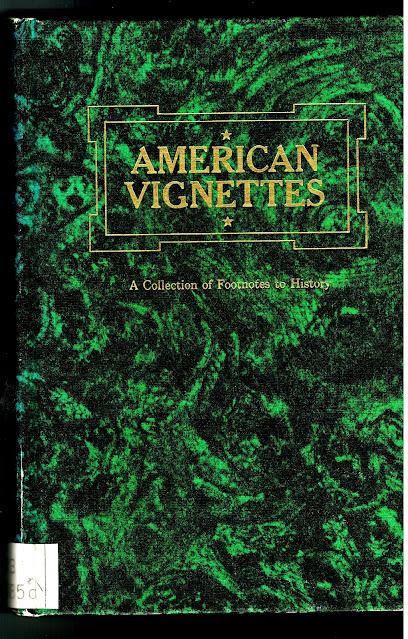
Library Book #2: American Vignettes -- Garbo


 Last week I started a new series of blog posts about stuff I bring home from our local public library. Today, the second post in the series.

I came across this smallish volume in a used bookstore somewhere, in the days when I would set a budget for myself. I did it fcor the same reasons that some people  visiting Las Vegas will bring only the money they are willing to lose. I remember thumbing through the pages of American Vignettes and finding myself drawn in, but I'd already spent the twenty bucks or whatever my amount was, so I left the book behind. And then regretted it for years. Recently I did a little internet research and realized that the item now sold for more than I wanted to pay. But our statewide library system had it listed and my local library ordered it for me. 


The subtitle for American Vignettes says it's a collection of footnotes to history. At first I thought the book was written just for school-age children but a closer look showed me that the writing was a bit more sophisticated for that. And while each piece is short, and relatively simple, about minor events or people whose names have been forgotten, these bits of history are compelling. 


The author, the late John I. White, was less famous for American Vignettes than he was for either history-based magazine articles or for his work on old-time radio. He also wrote a book, published by the Univerity of Illinois Press, about cowboy songs. His bio for Git Along Little Dogies says in part; "A former singing cowboy himself, John I. White spent decades compiling information on cowboy and western songs and the artists, songwriters, and others attached to them...  From "Whoopee Ti Yi Yo" to "Ten Thousand Cattle Straying," Git Along, Little Dogies ventures from cow camps to saloons to big-city radio studios as it lassos a vivid piece of American music history."  


Speaking of "Whoopee Ti Yi Yo," I found a YouTub video which contains John White singing the song, with impressive yips. 


John White sang on the old-time radio version of "Death Valley Days"  and this was the reason his brief obituary appeared in the Los Angeles Times. "John I. White found fame as the Lonesome Cowboy on the radio drama Death Valley Days in the 1920s and 1930s. He later became a businessman and magazine writer."


Some sheet music ffom White's radio heyday. . 


So White wrote (or compiled) American Vignettes in his senior years, and then some time after 1976, it  sat around on a used bookstore shelf till I encountered it. The compelling illustrations  originally helped draw me into American Vignettes, so some years later, when I picked up the library copy, I saw that the illustrator's name was Jerry Allison.  A quite internet search brought up  THIS BIO on a blog called The Shattered Lens.  The blog revealed the fgact that Allison did a lot of cover art for noir-ish paperbacks of the 1950s. Many of them were considerably more lurid than this one. 


When Allison wasn't drawing scared women falling half out of their clothes while frantic men with loosened neckties waved pistols around, the artist was drawing art for calendars given out to customers and gas station owners from the Esso (Esso = S.O. = Standard Oil) famous for telling us to put a tiger in our tank. 


Speaking of Esso / Exxon, there's a connection between American Vignettes'  tillustrator, Jerry Allison, and the book's publisher, TravelVision.


TravelVision, which published mostly maps and atlases, was based in the same New Jersey town where Honeywell thermostats were made. 


TravelVision published American Vignettes within a line of items given out to members of the Exxon Travel Club. 


If you always wanted to be part of the Exxon Travel Club, you can go onto online auction sites and bit on "mid-century" swag to be left around your house casually to impress visitors. 


By the bye, I discovered this week that he Travel Vision / Exxon people put out a companion volume to American Vignettes. It's called American Journeys and the cover has the same marbelized swirly pattern but it's reddish or orange-ish. I'll know which color for sure when I pick up the library copy, which I just reserved. And while I was at the library site, I also asked to get a copy of White's singing-cowboy book Git Along Little Dogies. Perhaps one or both with make it into this blog series..