Unlike last week, this Friday Amazon Prime has a new original (also having limited release in theaters) espionage thriller starring Chris Pine, Thandiwe Newton, Laurence Fishburne, and Jonathan Pryce. Ex-lovers
and spies Henry (Pine) and Celia (Newton) meet for dinner, where
reminiscences bring them back to a disastrous hijacking, with an
agency-haunting aftermath. During the meal, it becomes clear that some
old, deadly business is being concluded. It's All the Old Knives (2022 R 1h 41m)
*** *** *** *** ***
Fame is interestingin
its scope and lack thereof, along with how transient - ephemeral - it
can be. We see it all the time - when we recognize it, of course - with
sports, music, or general pop stars. People who can be known and
followed by millions, yet some small divergence of tastes and/or
geography, and they're reduced to a "Who...?" So it was for me and Jimmy Savile.
A
DJ who became a huge, "man of the people" style pop star, who generally
wore his hair long as part of a branding gimmick, he hosted Top of the Pops
for decades, and in large part he made a career of fundraising (mostly
for special hospitals) and of becoming someone who could make wishes
(particularly those of children) come true via a long-running tv program
Jim'll Fix It. Friend and confidante of the British royal
family, and of Prime Minister Thatcher, publicly meeting with Pope John
Paul II, he was one of the most well-known, highly-regarded figures in
the U.K. for most of the back half of the 20th century and the first
decade of the 21st. As it turns out, he was also - throughout it all - a
pedophile. For good or ill, it seems that infamy
outpaces fame. If I'd ever heard the name Jimmy Savile prior to his
death, I cannot recall it. It was only once he was being posthumously,
openly investigated, and then reviled, that I started to hear anything
about the man. A two-part documentary covering it all appeared this past Wednesday on Netflix: Jimmy Savile: A British Horror Story. While
normally, traditionally, I would have steered around such a thing, for
some reason I gave it a look and was drawn in. Again, there's something
fascinating about how deeply "known" someone can be - a cultural fixture
- by so many, while many millions of others have heard nothing. More
importantly, and terrifyingly, is realizing how something so damaged and
evil can hide in plain sight. Defined to popular satisfaction,
regime-approved and all eccentricities written off as mere gimmicks,
distracted otherwise by a string of Good Works, he was protected by a
glamour. One of the true magics of the world, turned to dark purpose. An unsavory character, but a story I found fascinating. The two parts run nearly three hours total. Thematically,
on the basis of evil hiding in plain sight, masked by the glamour of
celebrity, Important Friends, and very public Good Works, it's an
interesting companion piece to the four-part Showtime documentary We Need To Talk About Cosby that ran just this past February. (Has it really only been a little over a month?)
*** *** *** *** ***
Begun April 1st, with a new episode set to appear each Friday, a new South Korean fantasy series about supernatural workers in the afterlife, policing suicides, has shown up on Netflix: Tomorrow.
Our entrance to this is by a young, increasingly desperate job-hunter
who acts to save someone who's sunk even deeper into despair than he
has, unwittingly getting drawn into a whole new world and a major life
detour. It's set to run 16 episodes, and I've just begun giving it a look.
*** *** *** *** ***
As mentioned last week, we finally had the arrival of season five of Better Call Saul
over on Netflix, joining the previous four seasons. It's been
approximately two years since I'd seen these episodes as they aired week
to week on AMC. With the sixth, final, season set to begin April 18th, I
wanted to rewatch the previous season to get myself back up to speed.
There were some vague notions of spreading it out over the course of the
nearly two weeks in between. Have I met me? Yeah, I casually burned through the ten episodes in a few days. It's
a detail-rich environment, yet I was surprised at how fresh in mind
most of it was, though it was good to take the refresher. It not only
gave me more time to get back into the characters, but it reminded me of
a few details I'd forgotten, including that the season didn't end with a
snap back to the present, so a potentially dicey situation still waits
for us there. As with Breaking Bad, the
series this one is largely a prequel to (though with bookends that are
set well after that series wrapped) I expect to eventually go back and
rewatch the full series. It even crossed my mind to do that during this
gap before the final season begins, but that would be 50 episodes,
running anywhere from 41 to 60 minutes each. I've done more than that in
less time, but it's not a good idea. Anyway, I'll be more in on the series next week, when we're on the brink of the final season's start.
*** *** *** *** ***
We
otherwise seem to be in an odd spot, with significant releases coming
in the middle of the month and later -- a little too soon to get to
here. Instead, I'm continuing to enjoy series I've hit in previous Friday installments. Series that are still unfolding. Even just in my piece from two weeks ago, we have Atlanta (on FX, then on Hulu the following day), Moon Knight (Disney+), and a pleasantly unexpectedly engaging Julia Child biopic series.
The Julia Child miniseries on HBO Max, Julia, has continued to pull
me along. Without a doubt, were they not releasing this in weekly
installments, and had dropped it all at once, I'd have moved through it a
week ago. Sarah Lancashire has been delivering a moving performance as
someone who is overtaken by unexpected fame. A woman who has had to
navigate a life where she's too regularly felt like the unfeminine
elephant in the room, and has developed an array of skills to navigate
the world, is increasingly at sea in a world where her sudden and
growing fame has people treating her in a way she's never known. A
sudden intimacy and presumed friendliness that she can't help but be
unnerved by after a life of being mostly treated as a preposterous
figure. In the mix she's also getting to see that she's had more of an
impact on people from well before all this, but she can't bring herself
to really trust it. An undercurrent with Julia,
established early in the story, is that she's hit menopause, and so is
quietly dealing with the loss of the quiet, secret notion that she might
ever become a mother. With its loss she realized how the simple,
unspoken, possibility of it had been in some way sustaining. The
supporting cast is wonderful. Among them is David Hyde Pierce as
Julia's husband, Paul, an initially somewhat staid and priggish man who
we come to realize genuinely loves his wife, and grows past his own
professional disappointments to enjoy seeing her finally come into her
own. Contrasting
with
him in a small, but significant role is James Cromwell as Julia's
father, John. He couldn't really see his daughter for who she is, too
lodged in early life notions of her as am ungainly creature, with his
fatherly duty being to use his relative wealth to help her find some
place in the world, some part of him still believing that it's the only
reason she ever found a husband. The other main male character in the
cast is Russ Morash (played by Fran Kranz) an executive at public
television station WGBH, who is taken on a journey with all this that he
initially dismissed and fought against. The other men in the mix are
relative supporting players. Most of the
significant parts in this story are women. Running
parallel to Julia's own story are the other women who are navigating a
world that too reflexively diminishes, even dismisses, them. While a few
have solidly staked their claim and asserted their authority (such as
Avis, ably played by Bebe Neuwirth), most have to take a route of quiet
perseverance, acting more intelligently, tirelessly and boldly,
frequently needing to nearly ask forgiveness for making smart moves
while being the wrong gender. That latter path's the one walked by Alice
Naman (Brittany Bradford), one of the initially lower-tier production
people at WGBH, who is a young woman of color, and so operating with two
strikes against her even in the relatively liberal environment of
public television. She champions Julia's cause, and is instrumental in
guarding the spark of it, helping to tend it into full blaze. Four
episodes in as of this week, we're halfway through the story, it's in
that sweet spot where I'm hungry for the rest of the story, but already
feeling a little sad at it being over so soon.
I've also begun to sink into Tokyo Vice (also on HBO Max), one of the shows I gave an introductory look at late in last week's post.
*** *** *** *** ***
Despite
that long ramble, I'm once again pressed by other
circumstances, and have to wrap this up here for the week. A busy Friday ahead for
me, and I already want a nap. Today would have been the 61st birthday of someone special to me, who fell three days short of her 49th. I'm in need of a little, quiet, downtime, but I don't know if I'll get much of it. Miles to go. Take care. I'll catch you again in the
ides. - Mike
Since last time, it seems much of my viewing's been rewatches of older material. In large part as a
run-up to May's debut of Star Trek: Strange New Worlds, I wanted to revisit the first two seasons of Star Trek: Discovery. Sure, it's season two that sets up the characters we'll be following into Strange, but I wasn't going to just dive back in there. My
experience with season one had been choppy, as I'd watched the
CBS-televised first episode back in late September 2017, and it was off
in 2018 when a thumb drive with the files for the full first season made
their way to me. (I didn't subscribe to Paramount+ - well, it was still
CBS All Access then - until nearly the end of 2020.) It's been fun and
interesting to work through the first season again, "meeting" Michael
Burnham and the various series regulars again, now that I know they're
each interesting enough to pay attention to. I need this feature in Real
Life, because I really seldom know who to pay attention to the first
time around.
My late wife, Sue, was for whatever reason a big, big fan of the amateur stunts, practical jokes, and
exchanges of abuse that has been the Jackass
group's stock in trade since they debuted on MTV back in late 2000. I
knew another film in their series was coming a while back, and this week
it landed on Paramount+... so I watched it for her. Were she still
around, I know she would have talked me into lining up tickets and we'd
have gotten her wheelchair into a theater back in February, and so would
have added a little to the film's $78.1 million dollar worldwide box
office. All much as we did for her back in 2006 when the second movie
rolled out. Most of
the aging, damaged gang is back for this, save for Ryan Dunn, who died
nearly 11 years ago in a drunken crash, and Brandon "Bam" Margera, who
was reportedly booted off the site early on in this project due to drug
issues. Along with them are a mix of mostly younger people who are the
next generation of cannon fodder.
As
ever, it's an odd mix of masochism, (mostly) macho sadism, and
homo-eroticism, along with gross-out humor. There's a train wreck eye
magnetism to it all, mixed with a degree of nostalgia as a core group of
men who are now in their late 40s to early 50s engage in acts of
physical abuse that were unwise for any of them twenty five years ago.
Being well of an age where "sleeping funny" can leave me hobbled, I
wonder what state they'll be in by the time they cross the 60 line -- if
they cross it. Given the injuries they've already taken I'm guessing
it's all about keeping limber and accepting the pain of motion as the
price of admission to continued life. Here's
the trailer for the film, and the knowledge that even if they don't get
back together to do more of these they reportedly had so much film shot
that there will at least be a Jackass 4.5, which will include some other items and much of the behind-the-scenes material. Anyway: Jackass Forever (2022 96m), is currently streaming on Paramount+.
It's been nearly four years since the season two finale of Donald Glover's nuanced, layered, comedy-drama series Atlanta aired, but at long last season three began last night on FX (and on Hulu
as
of today) - dropping the first two episodes of a 10-episode third
season. Glover stars as Earnest "Earn" Marks, a college drop-out and
would-be music manager, and rapper Paper Boi (Brian Tyree Henry),
navigating the Atlanta rap scene. The series also includes Lakeith
Stanfield and Zazie Beetz, each of whom have subsequently enjoyed
success in films. All
in all an unlikely match for me, but much to my surprise the show
managed to catch my attention and the characters hook me early on.
Donald Glover, the series' creator, also composes and performs as a
rapper under the name Childish Gambino -- that's in real life, as they
say, not as part of this show -- so he's familiar with the professional
channels the characters are navigating. Despite
the long time coming, the return snuck up on me. I've not gone back for
a rewatch of the series, which I followed week to week during its first
two seasons. Fortunately, Kate Aurthur over at Variety, has taken a stab at bringing viewers back up to speed on where we last saw each of the players back in 2018. The
show had been greenlit for seasons three and four, and once production
resumed they were able to roll through the filming of both. The
fourth and final season is set to debut later this year. This current
season will be running Thursday nights on FX through May 19th - again,
showing up on Hulu the following day. Here's the commercial/trailer for this new season.
Wow! The new season came in with a kick! The season-opener, "Three Slaps", is essentially a standalone item that anyone could just watch, as it doesn't involve the cast from the main story, aside from a small linking/context scene at the end that the newcomer can simply ignore. It starts as a little horror story, then swaps that out for a much more real life one that's intentionally unsettling on more than one level, aiming to spark some conversations. The second episode hooks us back up with the series characters, much farther down their paths than when we last saw them.
Shifting settings sharply, while I've not given so much as a glance at the show's first season, I will at least note that the apparently highly-successful Bridgerton
(on Netflix) is back with an 8-episode second season today. Frilly,
historical dramas focused on high society, social status/climbing, etc.,
with Lady Ticklebottom and Lord Thistlethorn or such similar nonsense
are not anything I'm drawn to. However, I try to remind myself that if
it's well-written and performed, and deals well and cleverly with deeper
human and social issues, that the historical and fashion trappings can
fall away. I need only look to the previous item this week - Atlanta
- which overtly is focused on an urban setting and success in an
industry which identifies things as music that I generally wouldn't
classify that way, to remind myself that there can be ample rewards for
looking past the surface. Anyway, for what it's worth, here's the trailer for season two of Bridgerton.
Coming
up next week, on Thursday March 31st, will be the start of a new
comedy-drama biopic series on HBO Max, based on the life of television
chef Julia Child. As it'll be arriving Thursday, dropping its first
three episodes to start (of 8, with 1 per week dropping thereafter
through May 5.) I wanted to give you the opportunity to dive in as time
permits Thursday evening. It's Julia The
lead is played by Sarah Lancashire, who I can see is going to be a much
bigger deal to British audiences (and the more pretentious ones over
here in the states) primarily for her television work there. From what I
can see she'll be solid in the role, but it's just a case of my not
being familiar, it seems, with anything she's been in. My eyes are
perking up to see David Hyde Pierce, Bebe Neuwirth, and Isabella
Rossellini, though I must confess I didn't immediately recognize Pierce
until he spoke. That was a consequence of the full-retreat hairline,
fully appropriate for the role of Paul Cushing Child, Julia's husband,
who was a decade her senior. I'll be interested to see how both the performances and the points of history compare to Nora Ephron's final film, Julie & Julia
(2009), which featured Meryl Streep as Julia Child, and Stanley Tucci
as her husband Paul. While it's currently only streaming on Starz, or
available to rent or buy, I'll add the theatrical trailer for that here
even if just for a quick comparison.
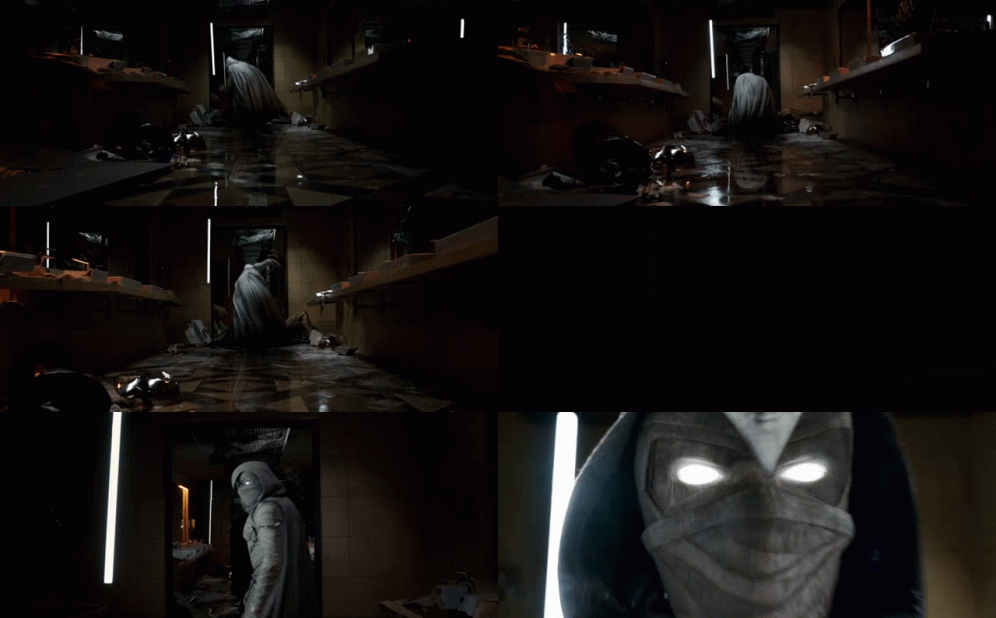
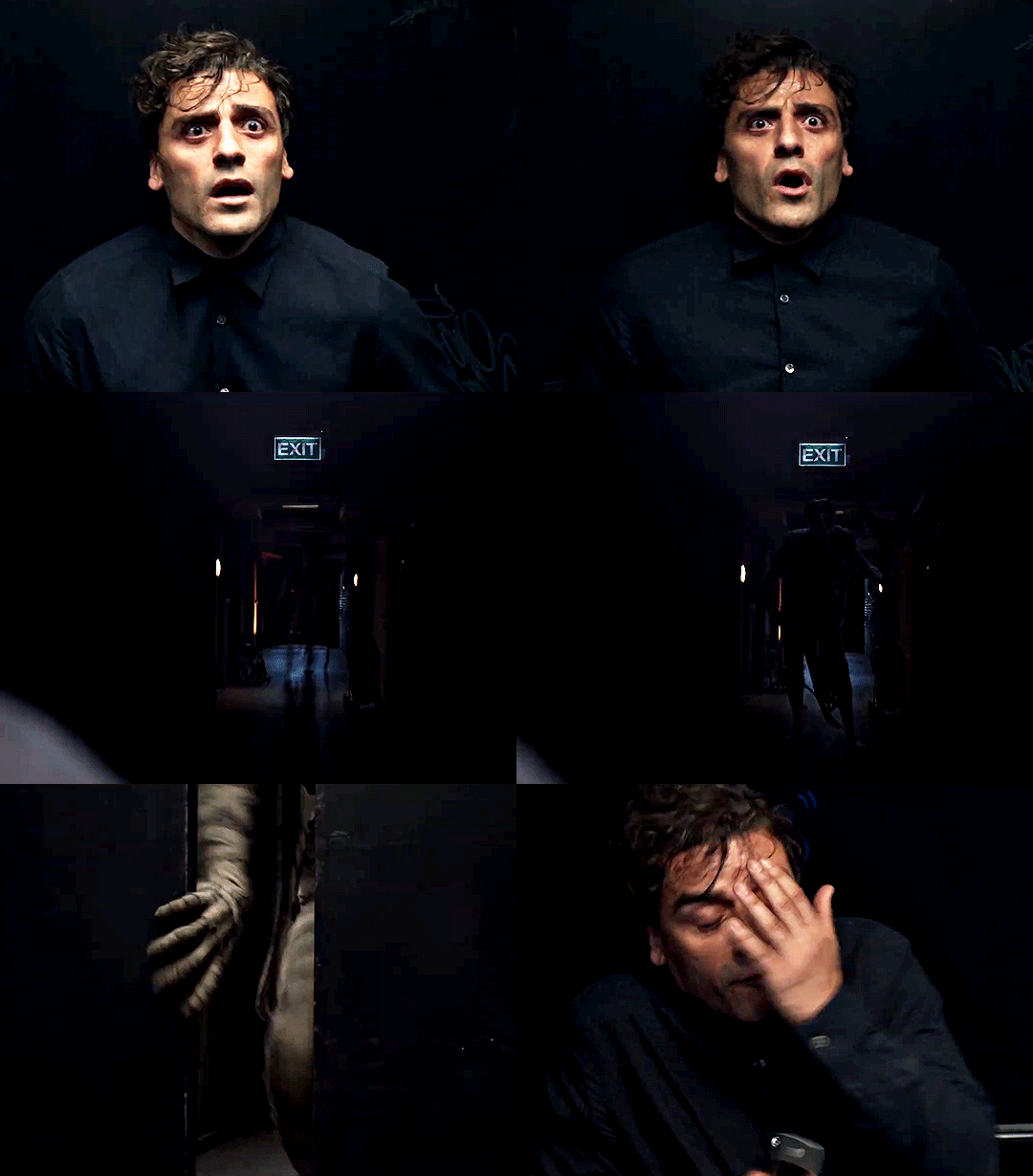
Starting March 30th (Next Wednesday), over on Disney+, is the latest Marvel mini-series, Moon Knight. They seem to be mining the underlying disassociative identity disorder
(what we used to refer to as multiple personalities) in a way
that lets them play with how much of it is delusional and how much a
genuine mystical influence. Centering
on a man who has ample reason to doubt his sanity, memories and actions
in general, it looks to be the most violent thing to come out of the
actual Marvel studios (the Netflix shows were done under a different
group), and is also yet another reason why the platform made the recent
addition of parental controls and added content previously prohibited. I'm
going to be very interested to see how they've chosen to adapt this
character, but I'm prepared to let it be whatever they've decided on, so
long as it all works.
As
we've gotten closer to the series, and we've gotten more of a glimpse
into it, I've tempered my expectations a bit with respect to the action
we'll see while he's in the full Moon Knight garb and doing something
other than beating someone with his fists. The other action scenes, in
full, caped costume - a negative image Batman, are meant to tap into
some fan expectations, but uncomfortably remind me of the
people-on-wires, fantasy combat moves seen in many wuxia -
stylized Chinese martial arts films. Certainly, this sort of thing
clearly works for many people around the globe, but it's never worked
well for me. A touch of it in the extended fight scene between The Bride
and the Crazy 88 in Tarantino's Kill Bill: Vol 1 (2003) was as much as I was up for. As an example, Ang Lee's international hit Crouching Tiger, Hidden Dragon
(2000) was, for me, a sleeping pill. If I ever make the effort to give
it another try, I may get past my earlier difficulties and engage with
it on a more emotional and cultural basis, as there's much going on in a
story with multiple levels, but the action sequences were the initially
and frequently praised draw and those largely failed for me with the
first bit of dreamlike, float-flying, wire antics. On a related note, as
much as I can admire the dedication and physical demands of the craft,
I've never been enthralled by ballet.
Anyway, with Moon Knight,
I'm expecting to mostly be drawn in by the seeming madness, interested
in seeing how deeply and far they're going to take the story down a
mystical path, and how long they'll keep any tension alive as to whether
or not this is purely a matter of perception, belief, and delusion. While
I'm very familiar with the comics source material, I know that
selective rewrites have often been made in these MCU adaptations, and so
that it's better to remain flexible. Best to try to appreciate what
they're building, instead of going the irritating route of slavishly
looking for adherence to source material. Too much time and energy can
easily be wasted by fans of print source material, sitting, arms-folded
in judgement (even if just in their mind), and too, too ready to inflict
"but, in the novel..." asides on companions who may or may not
be too polite to let you know they wish you were off reading something
and allowing them to enjoy the movie in peace. I'm still reigning that
in with every new outing, even just at the internal monologue level.
It's almost comical how I'll routinely come away from
a first showing of one of these adaptations with a "well, I liked it, but..."
review, with its litany of reservations. In each instance, once I
return for a re-watch (often years later) I'm pleasantly surprised that
it's much better than I'd remembered. Why don't I allow myself to have
nice things the first time through? Treading
a line between the source comics, which have undergone several creative
turns over the years, and what seems to have become the show's
narrative, the central character, Marc Spector, is a nearly life-lapsed
Jew, the son of a rabbi, who became a mercenary. A violent man who
managed to excel in a violent business, but then got in over his head in
one instance with a treacherous associate,
and
- depending on what one chooses to believe - either came close to death
and had a psychotic break, or died and was resurrected by the Egyptian
god Khonshu, a vengeful deity who wants to have human agency in the
world again. In the
show, Marc suffers from a dissociative identity disorder (what we older
folks still want to call "multiple personalities") that has become so
extreme that his personalities aren't initially aware of each other. The
series is referenced as a mini-series, the implication apparently being
that following this series the character will be appearing in movies,
rather than back for more seasons of this self-titled streaming series.
For now that's not important, but it's still a detail of interest to me,
as someone interested in the larger tapestry that's being woven here in
what is Phase Four of the Marvel Cinematic Universe.
Next
Tuesday (March 29), on both HBO Max and Hulu (and, as I understand it,
will also be on Disney+ come April 6th) the latest Kenneth Branagh
(director and lead actor) adaptation of one of Agatha Christie's Hercule
Poirot mysteries arrives to general streaming: Death On the Nile (2022 127m). As with the previous Branagh production, 2017's Murder On the Orient Express,
which also was from a script adaptation by Michael Green, there's the
challenge of not only aiming to faithfully adapt a fairly well-known
novel from the 1930s, but also will be competing with a similarly
star-studded 1970s theatrical version and at least one done for television. Again, too, it's a story of a
death happening in a fairly closed, exotic to most of us, environment,
in a distinctly period piece, under the carefully-trimmed mustache of
the famed Belgian detective. Here, too, we soon find a surfeit of
motives among the passengers. So, even as a source novel, it's a case of
a sequel trying to capture the lighting in the bottle of a previous
success. It'll be another case of trying to allow
myself to enjoy the production on its own merits, as opposed to going
immediately for comparisons to the earlier production and/or the source
novel. I don't think many doubt the sincerity of Branagh's affection for
the source material, though that's never a guarantor of a successful
final product. Among other factors there can be a considerable swing in
reactions from the audience based on both their affections for the stars
du jour chosen for the roles. Those familiar with the source
material (and of various adaptations of it over the decades) are free to
spot character changes, omissions, and substitutions, and speculate on
the motives (screenwriter, director, and/or studio focus group) behind
each. Having the relative luxury of being merely an
audience member, I'm content to take it in and try to enjoy it as its
own thing. Here's the trailer:
The
two things that hit me strongest are that it feels as if Gal Gadot's
star was riding particularly high when this was being cut together, and
that I'm not a fan of whatever pulsing song that is they've threaded
into the trailer. It doesn't seem at all evocative of the period --
though, of course, that's the basis for a long and impassioned
discussion of film in general, ranging from the choice of including
"Raindrops Keep Falling on My Head" in 1969's Butch Cassidy and the Sundance Kid, to the less casually anachronistic use of Scott Joplin's music in The Sting, as that was a couple decades out of step with the music of the period the film was set in.
This week's flashback freebie is another ABC Movie of the Week (in this case, weekend),
making for the third of these in a row. Unlike the past two weeks,
though, this is one that I honestly only vaguely remember the commercial
promoting it. Just a hair over 50 years old, this first aired Saturday
February 5th, and as I revisit the schedule for back then we likely had
the tv parked on CBS for most of that evening back in '72. Starring Elizabeth Ashley, Ben Gazzara, and a young Michael Douglas in a very early role, just before he hit as a co-star on The Streets of San Francisco.
In this horror-thriller/whodunnit, divorced mom Helen Connelly (Ashley)
lives on a ranch, with her daughter, Peggy. Her ex-husband is Doremus
(Gazzara.) Craig (Douglas) is a psychologist at an institute for
troubled youth. Helen begins getting calls from her nephew, Michael. A
big problem is that Michael is believed to have died fifteen years
earlier, and the voice on the phone seems age-appropriate for when he
died, not the voice of an adult. Michael casually drops details that few
if anyone outside the family would know. Following each call, someone
associated with the family from back around the time Michael "died"
dies. Helen's not sure if the calls are happening, or if she's cracking
up -- not to mention the worry that she may be the next one to go. Craig was Michael's brother, and both boys were in their aunt's care fifteen
years ago when Michael disappeared in a snowstorm, and was presumed
dead. It's When Michael Calls (1972 87m)
That's
enough for this time, no? When next we get together it'll be April.
That's scary enough all on its own, even before I remember that I
haven't gotten around to doing my taxes yet. As ever, take care, and meet me back here next Friday. - Mike