Happy Thursday, everyone! Let's jump right in; I've not bought anything new this week so you will have to enjoy what I've been going through what I've been packing for our imminent move.
_____________________________________
Seven writers each take a day of the week to say something. Currently a few authors rotate to post on Wednesday.
Happy Thursday, everyone! Let's jump right in; I've not bought anything new this week so you will have to enjoy what I've been going through what I've been packing for our imminent move.
_____________________________________
Newest installment of my ongoing suspense story, in which Bethany, from the southeast side of Indianapolis, tries to prevent her dangerous uncle from trying to overthrow the government while dealing with her own day-to-day struggles. Have you missed earlier episodes? CLICK HERE
This week's audio tale, in YouTube video form, is rather a long one. It would have been longer but I edited it down. In this story things come out all right at the end, but the story does involve non-violent workplace bullying so if you are not in a good place in your life, this one might be best saved for another time. Otherwise, here you go.
by whiteray
A funny thing happened in the year-end Billboard charts during the years 1965, 1966 and 1967.
Now, this is the kind of stuff that chart geeks like me notice, and it came to me when I was wandering through Joel Whitburn’s book, A Century of Pop Music. The book lists the top records of each year from 1900 through 1999 (a Top 30 in 1900 and a Top 40 from then on). I was tracking the most popular instrumental from each year, and when I got to 1965 and the two following years, there were none.
And that was a rarity. During the sixty-five years from 1900 through 1964, there were only six years when the year’s top records had not included at least one instrumental, and none of those years were consecutive.
But then came those three years in a row: 1965 through 1967. And that stretch without a big instrumental hit actually covered most of 1964, too. In December 1963, a surf rock band from Hollywood called the Marketts got their single “Out of Limits” into the Billboard Hot 100. It moved up the chart and peaked during the first week of February 1964 at No. 3. Its performance made it the No. 37 single for 1964, and it was the last instrumental single to do well enough to make the year-end Top 40 for four years.
So, what might have happened in February 1964 that altered the character of the music business here in the United States? Silly question, right?
Now, I can’t trace a straight line between the success of the Beatles and the two waves of the British Invasion from February 1964 onward to the dearth of instrumentals in the year-end charts, but there was certainly less room in those year-end charts – reflecting less time available on radio stations as well as less attention from retail outlets and record buyers – for American music of all types. What I mean is that I can’t cite causation, but it’s one hell of a correlation.
For example, the Top 40 for 1964 in A Century of Pop Music lists thirteen records by British groups while the Top 40 for 1963 in the same book lists none (although one artist each from Belgium and Japan is listed: The Singing Nun for “Dominique” and Kyu Sakamoto for “Sukiyaki”).
And it’s not like the earlier top-selling instrumentals were all middle-of-the-road stuff that would have been crowded out by newer genres. Yes, “Washington Square” by the Village Stompers, the No. 28 record of 1963, had been folksy and decidedly unedgy, but right behind it, at No. 29, had been the Surfaris’ raucous “Wipe Out.”
Still, I imagine it’s fair to say that most pre-Beatles instrumental hits were decidedly MOR, but some were not. To support the second portion of that sentence, I offer Booker T & the MG’s “Green Onions,” No. 38 for the year of 1962, and the Tornadoes’ “Telstar,” which was the No. 6 single that year. (And I also think of David Rose’s “The Stripper,” which wasn’t rock or R&B, of course, but certainly shook its stuff someplace other than the middle of the road and wound up as the No. 18 record for the year.)
Whatever the reason, for those three years – 1965, 1966 and 1967 – instrumentals failed to crack the list of the top records of the year. And it took a Frenchman to end the drought, with the first bit of instrumental rain falling during the first week of 1968, when Paul Mauriat’s “Love is Blue” entered the Billboard Hot 100 at No. 99. By the second week of February, the record was at No. 1, and it stayed there for five weeks. By the time 1968 closed its books, “Love is Blue” was the No. 3 record of the year (trailing the Beatles’ “Hey Jude” and Marvin Gaye’s “I Heard It Through The Grapevine”).
Four other instrumentals did well enough in the charts in 1968 to make the Billboard Top 40 for the year: “Grazing in the Grass” by Hugh Masekela went to No. 1 and wound up at No. 13 for the year. Three other instrumentals peaked at No. 2 and made the Top 40 for 1968: “The Horse” by Cliff Nobles and Co. was No. 19 for the year; “Classical Gas” by Mason Williams wound up at No. 24 for the year; and “The Good, The Bad & The Ugly” by the Hugo Montenegro Orchestra ended up at No. 27 for the year.
But Mauriat’s “Love is Blue” led the way, and more than fifty years later, it’s still a beautiful record:
I have a lot of stuff. It’s everywhere, unapologetically cluttering up all my spaces. All the stuff has to work for its existence. I don’t have time to look after it or keep it all that clean. It can’t be high maintenance. Clean enough is good enough. I’m in no way neat, but I like to have a place for everything. The stuff I own has to be really nice or really useful, preferably a bit of both.
I’m quite guarded about my own stuff at work. I’ve had to learn that the hard way – I’ve loved & lost stuff too often - so now I never lend books nor DVDs & I only lend other stuff with the passive aggressive & casually delivered, “Just put it back in this drawer when you’re done with it,” with a tight smile & deliberate gesture towards said drawer. Just because the stuff has to earn its keep doesn’t mean I don’t want to decide what happens to it.
Artists get this. They know about clutter & stuff & the comfort it can bring. Sometimes they live it & it’s one of the many ways they can communicate that they relate to us. There are examples of people’s stuff in various art world guises. It represents something about us, how we live, how we see space & the stuff we own; why do we “need” it, value it or keep it? What does it tell us about ourselves & is there anyone who’s NOT aware of this? & people that don’t have much stuff or a place to live will surely need some handy bits & pieces. Even the tidiest of people with a home & the minimum of possessions needs a bathroom cabinet. This week’s blog goes in search of stuff & finds it.
Ephraim Rubenstein (b. 1956), Book Pile XXXIV (?)
I have to say, Rubenstein has painted some much more upsetting, even triggering images of books, ones that are scattered around open & face down, which no matter how messy my space might get, I’d never do. I actively discourage it in others. Books constitute a lot of the stuff we have in our flat. My partner & I love books & until lockdown I never thought I’d ever buy a kindle. So now, I not only have piles of books to read plus the ones in the many bookcases, but I also have a virtual bookpile. Thanks, kindle.
Tim Nobel & Sue Webster, Dirty White Trash (With Gulls) (1998)
This artistic duo have cleverly fashioned the stuff - rubbish – to create a shadow that makes sense when lit in a certain way. With added gulls which is a plus. Of course they are making a valid point about what stuff we use, what we throw away & what happens to it next. They reject the idea of waste & in a way that’s the most pro-stuff I can think of. There is hope & a bid to make us feel accountable in their work.
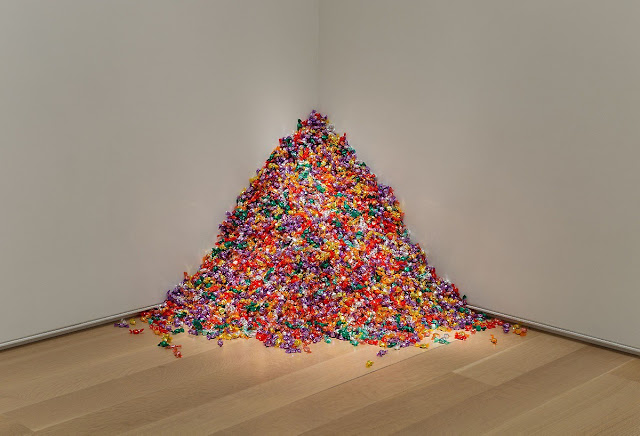
Felix Gonzalez-Torres, An Untitled Pile of Symbolic Candy (Also Known As “Ross in L.A.”) (1991)
This was created at the time when the partner of Gonzalez-Torres was dying of AIDS. People were allowed to take the sweets from this & other similar installations, perhaps not realising the symbolic intent. The idea was that as the pile of sweets diminished, it represented the chipping away of the body & functions of those dying of the virus. Though as one website notes, “While the candy is eaten, while the body begins to disappear, the love remains.” This stuff is the stuff of love itself.
Tracey Emin, My Bed (1998)
It annoyed a lot of people at the time. Infuriated them in fact. Especially as it was nominated for a Turner Prize. People thought Tracey’s stuff was merely rubbish but she too made it into art. It represented a time when she did nothing but stay in bed for four days in a depressed state, not eating & drinking nothing but alcohol. She said more recently that she likes to look back on it as something that doesn’t epitomise her life any more.
Richard Bawden (b. 1936), Clutter (?)
Here is a man & his stuff. At first, I liked this painting very much, but then I saw the man’s expression & now it gives me the creeps.
Ric Darrell, Craft Drawer Clutter (before 2017)
One of the most relatable images of stuff I could find. It’s become a cliché: “who doesn’t have a drawer like this?” It’s made with digital pen & coloured pencils. & here I was under the misapprehension that digital technology was meant to help us dispense with physical stuff.
Igor Zhuk, Artist at Work (2006)
The stuff of artists & their studios in art is a popular theme. It’s perhaps an attempt to allow the viewer to see what they want us to see. Perhaps the stuff has been tidied up for the picture. Anyway, it amuses me to wonder whether those are bottles of turps or whisky & whether this artist gets the teacups muddled up with the paint pots…
Chris Roberts-Antieu, The Collector (2017)
Though nothing like his style, this makes me think of Gustav Klimt’s portraits, where the person is painted & then besieged by patterns & decoration that perhaps represent them in some way. Here the person surrounds the stuff, however.
Joe Orton, Bedroom (to 1967)
Technically, this would have been also made by his partner Kenneth Halliwell, but if Joe’s own sister can’t forgive Halliwell for murdering her brother, I don’t see why I should give him credit in a subheading. In any case, this always reminded me of my bedroom at home. Before seeing Joe’s version, I covered mine completely at one point, including the ceiling. It’s stuff alright. You might not consider it art, but it’s a thorough expression of our inner selves & the things we love. Plus, if you look closely, you can see Rembrandt, da Vinci & Michelangelo represented. So if you want to quibble, the art is there.
David Teniers the Younger, The Archduke Leopold Wilhelm in his Painting Gallery in Brussels (1651)
Hot on the heels of Joe’s wall is this gallery, a room possibly worth more in monetary terms than a small bedroom pasted with newspaper & magazine cuttings, even if said bedroom is situated in Islington. With a title as busy as the picture & weighing in at 104.8cm x 130.4cm, everything about it screams “stuff as status symbol.” Look at my stuff, look at my great taste, look at the stuff I can afford, look at all of it!
Okay, does anyone else now feel like “stuff” is a really weird word?
Just past the mid-point of March - the Ides, then St. Patrick's Day now just behind us. Much in the news to depress us, the majority of which are matters where our only controls are on how we choose to react to and weather them. Being aware of them is worthwhile, but living with them constantly is needlessly harmful, an act of self-terrorism. Let's see what and who else is out there to spend some time with. As with last week's post, as I get around to watching some of the items I'll aim to come back and add follow-up notes in this deep blue font.
Arriving today on Hulu is a new erotic psychological thriller starring Ben Affleck and Ana de Armas. It's Deep Water (2022 R 2h 33m)