I have packed, unpacked, and repacked the same abridged recording of Desperation by Stephen King and the companion The Regulators by Stephen King writing as Richard Bachman.
The most appealing thing about them is the cover art. Oh and Kathy Bates reads one of them. But they are among my hubby's favorite stories from his childhood. I got ambushed with Regulators immediately after Doctor sleep, when I really could have used a break from King.
My first impression of this story cam be summarized by my primary query after the first listening session: "Just how much coke do you think Steve was on when he wrote this? "
Disappointingly, the answer is none. I could summarize the story for you here, but honestly, if you haven't figured out what's going in by the end of chapter 5 or so, you haven't been paying attention.
So much of this book feels like an amateur's attempt at Agatha Christie's breadcrumb technique. I say "amateur" because where Christie leaves a barely there trail you have to know to look for in order to see, Steve lays down big, obvious, paving stones, in a bold path.
Normally, I prefer the Bachman books. I am sad to say that this is the first Bachman book I found nothing of merit or value.
You ever had a chance to see Robert Altman's wonderful 1975 film "Nashville"? It's one of Altman's full-ensemble movies, with lots of characters whose lives are interconnected. The assistant director, Alan Rudolph, went on the next year to direct (under the auspices of Robert Altman) "Welcome to L.A." It was not the big hit that "Nashville" was.
If you have been following my series of posts about Greta Garbo's movies, you may be wondering where I am going with this, and I don't blame you. But give me a few paragraphs and I'll bring us 'round to where I need to be.
One factor which made "Nashville" a hit was its excellent soundtrack. The LP included a folk-rock number by actor David Carradine, who was looking a bit like the "Doonesbury character" Zonker at the time.
At the tine "Nashville" was released, Carradine, who comes from an acting family, was known to us as the brother of the actor who played lead character in the TV show "Kung Fu." Here's the opening to the show:
So, to recap: David Carradine was in "Kung Fu," his brother Keither had been one of the ensemble in "Nashville" and his song "I'm Easy" from the "Nashville" soundtrack. Alan Rudolph, the assistant director for "Nashville," went on to direct "Welcome to L.A." and he cast Keith Carradine as the lead in the latter film. In this role, Carradine no longer looked like Zonker from "Doonesbury, but more like a beatnik, a cross between Shaggy from Scooby-Do and Shaggy's inspiration, Maynard G. Krebs.
In 'Welcome to L.A.", Carradine plays another singer-songwriter, and this time he earns his daily bread as the driver for a private car service. In this capacity, he chauffeurs an unhappy housewife, Karen, who's played by Geraldine Chaplin. (She's the woman in the photo at the top of this post. )
Even though the setting is contemporary for this mid-70s film, Karen is dressed like an actress from the Golden Age of Hollywood. She pays Carroll, Carradine's character, to drive her up and down the streets of Los Angeles while she coughs delicately into a lace handkerchief, in tribute to Greta Garbo in "Camille."
"Camille," released in 1936, is based on an 1848 century novel in which the heroine's romance is doomed because she is dying of consumption (tuberculosis).
The film is directed by George Cukor, and while I am not sure that Garbo's spare Scandinavian face was ever meant to be surrounded by ringlets and sausage curls, or that Robert Taylor seems all that in love with The Lady of the Camellias, the movie does have opera-box intrigue, which I do love.
Here's the trailer for the film, selling us Garbo + romance:
After it was a novel, the story of Camille was both a play and a movie, but it's also been a ballet. Here's a video clip of dancers doing a bit of that.
If this is starting to seem a little familiar, that's because one of the world's best-known operas is based on the same story (there was a real Lady of the Camellias). Of course, it's La Traviata.
Next week: "Conquest," with Garbo in sausage curls again
There is music at
the end of this post, even though the post itself – which I wrote some years ago
– is not at all about music. It’s about today’s date and memories that are
fifty-eight years old.
Blank
stares. That’s the thing I remember most about November 22, 1963, the day
President John Kennedy was killed.
I
was ten and in fifth grade that November, and for some reason, I’d had lunch at
school that Friday. I usually walked the five blocks home for lunch, but Mom
must have been away from home that day for some reason, a church women’s event
or something like that. So I was in the classroom during the brief after-lunch
free time when Mr. Lydeen came into the room with an odd look on his face.
He
told us the news from Dallas, and we stared at him. I think some of the girls
cried. And we spent the rest of the day milling around the room, gathering in
small groups, the ten or so fifth-graders and ten or so sixth-graders of our
combination classroom. We boys talked darkly of what should be done to the
culprit, were he found. We were angry. And sad. And confused.
At
recess, we bundled up and went out onto the asphalt and concrete playground,
but all we did was huddle around Mr. Lydeen, our backs to the northwest wind. I
don’t recall what we said, but I think we were all looking for reassurance, for
explanation. Mr. Lydeen had neither for us; I remember seeing him stare across
the playground and past the railroad tracks, looking at something beyond the
reach of his gaze. The blank look on his face made me – and the other kids,
too, I think – uneasy.
Mom
was listening to the old brown radio on the kitchen counter when I got home
from school that day – a rarity, as the radio was generally on only in the
morning as we prepared for the day. And it stayed on through dinnertime,
bringing us news bulletins from Dallas and Washington and long lists of weekend
events cancelled or postponed. Not much was said at the table, as I recall, and
I saw that same blank look on my parents’ faces that I had seen on Mr. Lydeen’s
face that afternoon.
That
evening, I sought solace in my box of comic books and MAD magazines. By
chance, the first magazine I pulled out of the box had a parody of a musical
film, one of MAD’s specialties. But the parody poked gentle fun at the
president and his cabinet, and if it seemed wrong to laugh that evening – as it
did – it seemed especially wrong to laugh at that. I threw the magazine back
into the box and went in search of my dad, who was doing something at his
workbench in the basement.
I
watched him for a few minutes as he worked on something he had clamped in the
vise, and then I just asked, “Why?”
He
turned to me and shook his head and said he didn’t know. And I realized for the
first time that the people I looked to for explanations – my parents and my
teacher – were unable to understand and explain everything. That was a scary
thought, and – being slightly precocious – I pondered its implications for a
few days as we watched the unfolding events on television with the rest of the
nation.
Sometime
in the late 1990s, about five years before Dad died, I was up in St. Cloud for
a weekend, and he and I were drinking beers on the back porch. For some reason,
I asked him what he remembered of that day. He’d been at work at the college
(not yet a university), and he remembered young women crying and young men
talking intensely in small groups. And, he said, he remembered not being able
to give them any answers at a time when they so needed them.
I
nodded and sipped my beer. I thought of the cascade of events that followed
John Kennedy’s death, the twelve or so years that we now call the Sixties: The
civil rights movement and the concurrent violence, the long anguish in Vietnam,
the deaths of Malcolm X, Martin Luther King Jr. and Robert Kennedy, race riots
and police riots, the National Guard and the police opening fire and killing
students at Kent State and Jackson State. I thought about draft cards, protest
marches and paranoia and about the distrust and anger between black and white,
between young and old, between government and governed.
And
I looked at my dad and said, “Yeah, John Kennedy’s death is when it all
started.”
Dad
was a veteran of World War II, part of the generation that came to adulthood
during the Great Depression. His generation, after it won its war, came home
and lived through a hard-earned era of prosperity that will likely never be
matched anywhere in the world ever again, a time of Father Knows Best and the New York Yankees. From that perspective,
my father looked back at November of 1963 and then he looked at me.
“No,”
he said, “that’s when it all ended.”
The late singer-songwriter Phil Ochs
responded to the assassination with his song “Crucifixion.” The first version I
ever heard came from the late Glenn Yarbrough on his 1967 album, For Emily,
Whenever I May Find Her. Here it is.
Loving this visit to another eternal city, fragile as it may be.
Notes: thumb down (because 2 thumbs would be disrespectful) to Cafe Dumonde. Bad coffee and mediocre beignets, sad to say. It's an institution most definitely, but I guess we are all spoiled by much better coffee preparation these days.
Thumbs up to Frenchman's Street, and The Old Absinthe House.
I've completely loved the New Orleans experience. The architecture, history, and mood of the place is very appealing. Of course, this is a visit had in November and I'd surely feel differently in August, and the weather has been very mild for our trip. The residents and shopkeepers of the French Quarter have been helpful and friendly and kind. Upon exclaiming, "I smell pot everywhere and don't see anyone smoking it!" I was given a small twisted up cigarette cellophane of a joint's worth, by a sweetheart of a man who approached me, as, apparently high on Absinthe, I'd directed my exclamation at him! This morning I returned it to him, at his "sitting spot", along with delicious shrimp & grits, some orange blossom soap, and a heating pad, (he had walked up to me on his cane). He's my Mister Angel, now.
There is a great deal of chaos and debris here as well, plenty of spice. But once here, it's hard to resist the energetic flow of the place. Don't worry though, there are plenty of oases to be had. I practically ran away from a parade last night. But one block over it was peaceful enough for a woman with sore feet and sensory overload to relax and enjoy the night air as we walked back to our hotel past the everchanging shop windows and fragrant cooking smells.
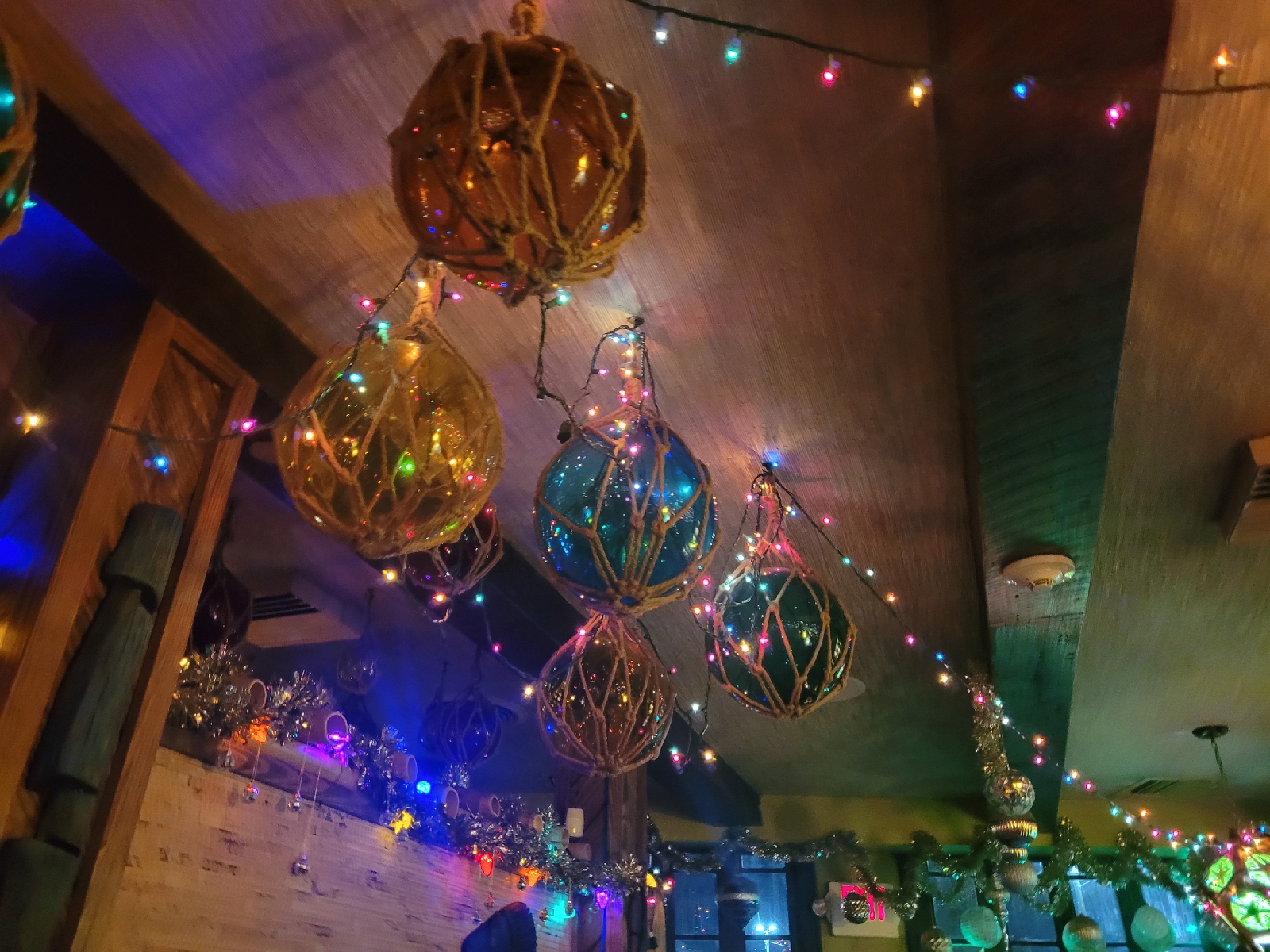
Back at the hotel, we settled in at Beach Bum Berry's Latitude 29, pics at the bottom. Whoever decorated this place for Christmas is a real artist.
I am finished with the colour system…& await a new development…one just keeps going like a machine. I have to paint.
Still Life - Apples & Jar (1912-16)
There are a number of artists that look like nothing more or less than a stereotypical accountant. I’m thinking of guys like Arthur Rackham & Antony Gormley for instance. From the minds of all these incredibly square-looking fellows often comes the most innovative & interesting art. & so it is for Samuel Peploe. There’s a photo of Peploe that shows an art school class where he has selected a moustache & cravat combination as his look. A part of him chooses to look like this. He’s building up an image, a public image. Perhaps in 1893 the look was downright avant garde.
The Coffee Pot (1905)
Coffee & Liqueur (c.1905)
Surely most municipal galleries in Scotland will have acquired a Peploe - he’s so prolific - & each of those galleries will be thoroughly delighted about having it. It makes me happy to think he, in particular, came from Scotland, despite his travels (most artists then seem to have left at some point in their careers) because of his imaginative approach to colour & style of painting, his need to keep moving forward with his art. There is something deeply European about Peploe. There are many contradictions in how we view Peploe & perhaps in how he viewed his own work. Possibly it was simply a fearlessness about progressing his work. He was a machine. He had to paint. No matter where that would take him.
The Black Bottle (c. 1905)
Still Life (c. 1910-12)
There were apparently also contradictions between his public & private personalities. Samuel’s grandson, Guy Peploe is the director of Scotland’s oldest commercial art gallery, The Scottish Gallery. The gallery recently presented an expo (& accompanying book) representing the studio days of Peploe. Guy Peploe has also written a lavishly illustrated biography of the grandfather he never knew, wherein he tells us that as staid & aloof as Samuel appeared to the public, his family found a man with a sense of humour that was fun & entertaining.
Comrie with Landscape & Clouds (1901)
Still Life (1913)
As a SJ Peploe fan in the 21st Century, much of his work still seems ground-breaking & new. He’s perhaps known best for his still life paintings & sea- & landscapes. Many have a distinctive Cézanne-esque blue or black outline to the different elements, denoting the often rapid, often impasto placement of paint on canvas. You can’t effectively produce paintings with such confident & hurried brushstrokes without endless practice & familiarity with the materials. This was the case with Samuel. Despite starting his working life with a solicitors’ firm, he could be found outdoors drawing on street corners in his breaks.
A Rocky Shore, Iona
Kirkcudbright (c. 1919)
{Kirkcudbright is pronounced Kur-koo-bree}
The quote from Peploe at the start contains some big words for one of a group of artists known as the “Scottish Colourists.” But this is what you see when you follow the timeline of his works. You can trace development & change in all artists’ oeuvre over time but after conducting even a cursory study of Peploe’s works you will be presented with an ability to roughly date what you’re viewing – was it early 1900s? Or 1910s? Or later? Pay not very close attention & you’ll soon be able to tell.
Self Portrait (c. 1900)
Although he’s labelled a Colourist - & correctly so for the group he was associated with – he’s a stylist, as was his great friend & fellow Colourist JD Fergusson. Like Fergusson, he’s not reaching for perfection; he’s after constant change.
Yet again though, he confounds us. He wants to develop, yet he returns to the same places, the same subjects, uses the same models & in this way. But it turns out it’s a good move as he is able to affect continuous variation in his style, use of colour & application of paint.
Ink Drawings
The names of his paintings are often nondescript because he’s not trying to say something. He’s trying to see what can be done, what can be achieved in paint. His still life paintings in particular show the most marked changes. At first, they are almost like landscapes (although extremely accomplished & well composed) – wide, on a single level, expansive, with plenty of space. Later though, as they become more abstracted, almost Cubist in places, the arrangement is much tighter, there’s less space, less room for manoeuvre or error & the placement of the different shapes & objects becomes more impressive. He doesn’t put a brushstroke wrong. He now fully understands the power of composition. He no longer has to show off with it to astonish us. He is now an expert.
Pink Roses, Chinese Vase (c. 1916-20)
I did think quite hard about what my favourite Peploe painting might be & I couldn’t come to a conclusion. I like the idea of him, his contradictions & his ever-changing style. Therefore if someone was to say I could have one for myself (no-one is going to say this) & I could only pick one, I would have no hesitation in selecting one of his self-portraits of 1900. In the tradition of many great portrait painters, he paints himself at his work, setting out what he does & who he is. You can almost smell the tobacco – he would find smoking helped him think & consider & solve the problem of creating the next image.
But this image, holding our gaze in a fug of perfectly-placed smoke he paints. Everything is clearly, swiftly, deliberately & economically defined in thick impasto & not a brush-hair is out of place. It’s a perfect summing-up of his abilities as well as his life & self-image. We can see the smock covers his snowy white shirt & smart tie. We need no more detail that what he has set down. Our brain fills in the rest.
In a short autobiography from 1915, Peploe encapsulates the World of Art in a single sentence, where many – myself included – have failed. Although in the context of the piece he wrote, he may have meant that he had to get on with working considerably harder after the births of his sons, he will also have understood the other potential meanings of the stand-alone statement:
Next
week - believe it or not - will be for those of us in the U.S.,
Thanksgiving week. Those of us with office or similar jobs may be
looking forward to a four-day weekend, so by this time next week we may
have decadently devolved into overfed, possibly intoxicated, house cats,
having fallen into holiday mode by Wednesday night. Aspirations. Let's
see how that works out on each front, from what's happening at work, to
whether or not I'll have my car back (and what it cost me) and if I'm
chosen as a juror on Monday. (Yeah, it's been three years and I'm back
in the pool. Yay.) Jury update: They decided I didn't need to come in Monday, tossing me back in the lottery pool for some other time. So, at least one complication's off the table for next week. Keeping a good thought, and getting on topic: For
those of us both with Disney+, and who are also so inclined, we'll have
the opportunity to kick off that Wednesday with the first two episodes
of the six-part Hawkeye series, the latest entry from the Marvel
Cinematic Universe. In large part it's a legacy tale, setting up a
young, female character to take on the titular mantle. Stars Jeremy
Renner and Hailee Steinfeld, and will both introduce at least one new
action character (Echo, a deaf character with an aptitude for duplicating fighting styles she's seen), while also bring us the first new appearance of
Yelena Belova, the new Black Widow (played by Florence Pugh), since we
were introduced to her during the Black Widow movie. As
mentioned, the first two episodes drop Wednesday, then there'll be one
new one each week through December 22nd. So, starting just before
Thanksgiving and ending a few days before Christmas - which fits in with
the time frame of the series itself. Landing that same day (Wednesday) over on Amazon Prime is the third (and final) season of the action drama series Hanna. I'm left in a weird, senior moment state where I can't 100% recall if I got around to season two... On
Thanksgiving (the 25th) itself, on Netflix, an anime, super-action
series, part of Mark Millar's Millarworld block of properties, lands.
It's the less-than-stunningly-namedSuper Crooks. On Disney+, starting on Thanksgiving, we'll finally get to see the first of three parts of Peter Jackson's documentary The Beatles: Get Back.
Originally intended to be a much shorter theatrical release, the timing
of the pandemic pushed Jackson even deeper into his editing process (he
ultimately spent roughly four years of studio work on it) and saw the
project evolve into three, 2-hour long parts, which we'll see that
Thursday, Friday and Saturday. Jackson had access
to roughly 57 hours of film and 140 hours of audio, previously from
which Michael Lindsay-Hogg's 1970 documentary Let It Be was
assembled. Jackson took pains to avoid reusing any of the film that
appeared in that earlier film, and used film restoration techniques
developed for They Shall Not Grow Old to restore a vibrancy to
the footage. A substantial difference between this new project and the
1970 documentary is that the earlier film had an overall negative tone,
and felt more like a headstone for The Beatles, whereas much of the
source footage spotlights the camaraderie and fun that was still an
integral part of the band-mates even in what would prove to be their
final sessions as a group. I'm looking forward to this. As for things that are either already here or which will be available sooner... I'll begin by pointing back to last week's piece, where I mentioned The Wheel of Time fantasy series getting started on Amazon Prime, and the live-action version of futuristic bounty hunter noir anime Cowboy Bebop landing on Netflix - both as of today. Also noted last week, the new season of Star Trek: Discovery began yesterday on Paramount+, and it hit the ground running. Also newly-arrived on Netflix is another Korean import. Season 1 (6 episodes) of Hellbound,
centers on people who gain foreknowledge of their own deaths and fates
in the afterlife, and are subsequently hunted by "death angels." The current marketing
reference point, especially as this is also from Korea, is the
speculation that this might be "the next Squid Game," which only
means they're hoping a week or two from now it'll trend strong for
viewers and be a hot topic. As this is directed and co-written by
Sang-ho Yeon, who made his huge international splash with the
fast-zombie/contagion instant classic Train To Busan, I'm encouraged.
I'm genuinely
interested in seeing how the metaphysical and moral details are handled,
and far less in the cgi menaces - which remind me of the Cavity
Creeps, with stringy body hair. This one caught my attention strongly enough that I'm four episodes into it, and aside from a couple, short-term quibbles, I've been enjoying it -- complete with rollercoastering emotions. We see that however seemingly implacable the supernatural threat, the one from other humans ends up being arguably worse. I'm very interested in seeing how this plays out, given the concept twists. Something that, if you care, you're likely already aware of, is that there's a second season of "reality" show Tiger King.
I'm one of those who didn't make it past the promotional materials with
the first season, despite the pandemic, so I can't tell you anything
more about it than what they show in the trailer... and if you watched
the earlier season I'm guessing it'll all mean something more to you
than it does to me. Every time I got anywhere near the show I wondered
why I'd want to spend any time with these people, and never came up with
One
last one for Netflix - tossed in here more for the sake of variety than
immediate interest on my part, is a musical about a man on the cusp of
30, coming to terms with his life. Starring Andrew Garfield, written by
Jonathan (Rent) Larson directed by Hamilton creator Lin Manuel-Miranda It's the semi-autobiographical (Larson's) Tick, Tick... Boom! (2021 115m). What
I believe is the last of the Marvel Television development shows - from
back when they were keeping those separate (they were folded into
Marvel Studios operations in 2019, where several of the planned projects
were humanely snuffed) - reached Hulu this week. It's a Marvel show
largely only inasmuch as Marvel comics published some comics involving
him circa 2010, some of which included other Marvel heroes/villains and
anti-heroes, including Deadpool and Spider-man. It's Hit-Monkey. So,
it's here, in its spot on Hulu, and should offer some violent action
and fun if one's in a receptive turn of mind. The voice cast includes
Jason Sudeikis, George Takei, and Olivia Munn. Ten episodes, each
running between 22 and 27 minutes, all dropped in place at the same
time. A
tip from old pal L. Laney Loftin put me on to a series of roughly 7 to
15-minute pieces that spotlight failed, single-season shows, providing
an overview, background and highlights. Called 13 Week Theater, it's available on YouTube. The majority of these were tv failures I was aware of, though in many
cases not ones I'd seen as their low number of episodes and lack of
success made them unlikely to be syndicated. Fun not only for the
general theme of debacle, but also in remembering failed shows that
contained later stars, some that might have hit in another time, and
even one or two that were likely cancelled too hastily, like the
1965-'66 Gidget, which fizzled during the main season but became a
breakout hit during summer reruns... too late to call everything back, as actors had been released from contacts and the studio demolished the sets. There are also episodes focusing on
CBS and NBC's failed attempts to cash in on the 1966 camp superhero show splash
that ABC's Batman had, Mr. Terrific and Captain Nice. Of course, there's an episode for Fred Silverman's near network-bankrupting 1979 failure, Supertrain, too. Here's the 13 Week Theater series promo. Surely,
there are more than enough suggestions above on which to squander your
waking hours in the coming week! Take care, and ideally we'll all be
back here next Friday, fat(ter), happier, and looking for the next thing to
watch. - Mike
Happy Thursday, everyone! I hope everyone is having a good week. No light-hearted banter for me this week, as will become apparent. So let's dive right on in.
_______________________________________
Last week, my father died. Daniel Finn was a good man, a good father, one I disagreed with a lot but I almost never felt he was straight-up wrong. (Well, there was how he, a life-long democrat, voted in 2016.). So I figured I would feature a movie I watched the other night that he introduced me to as a kid and I've always loved.
1963's The Great Escape is a very fictionalized version of a real-life occurrence, the escape of Allied prisoners of war from Stalag Luft III in Poland in WWII (based mostly on real-life British escapee's memoir of the same name, which I highly recommend). The real life story is fascinating as hell and it's really impressive how this version (directed wonderfully by John Sturges) gives every character room to breath and develop. And GOD, this cast. Richard Attenborough. James Garner. Donald Pleasance. James Coburn. Steve McQueen. David McCallum. A whole host of other US and British character actors. This movie is a delight of good performances that never forgets it is set in a WWII POW camp.
And good god, that theme music.
The Great Escape is available for rent/purchase at the usual places and is streaming with ads on the Roku Channel.
________________________________________
A random find for me this week of an Ishiguro I've never read. I've not read of much of his work as I should have, considering I think his Novel Prize is one of the best of the last 25 years, so this one I was very happy to run across. This is an edition from Faber and Faber, the London publishing house that is close to a hundred years on in excellent British publishing.
I don't have much to say about this, but I did finally recently see the movie version of Ishiguro's Never Let Me Go, one of the saddest science fiction novels I've ever read....and the novel holds that feeling up. I will always recommend an Ishiguro, be it NLMG or Remains of the Day.
Never Let Me Go is streaming on HBO Max and very much worth your time.
________________________________________
Did you know there are Criterion Collection knock-offs from The Republic Of Korea? I didn't! It looks like this is all-region, so I took a flyer on it. (I do love Cocteau's Beauty and the Beast.)
The Blood Of A Poet is streaming on the Criterion Channel.
________________________________________
So many people talk about Monroe in Some Like It Hot, but I do think this might be her better movie. A Technicolor noir set at, yes, Niagara Falls, this is some real good fun of weird double-crosses and marriages gone wrong and huge vistages of water and betrayal. And come on, Joseph Cotten! This is his second best noir after Shadow Of A Doubt.
Niagara is streaming on Criterion Channel and Flix Fling.
________________________________________
Finally, this is my skull Boris thatI found last year. Say hello to everyone, Boris. Yes, for Karloff. I could have gone with Yorick, but he looked more like a Boris.
Which leads me to my schlock recommendation of he week, 2000's The Skulls.
You will be hard-pressed to find a movie that is both so weirdly stupid and also so weirdly entertaining. Director Rob Cohen went on to also direct The Fast And The Furious and xXx and that should tell you exactly the kind of dumb movie you're in for.