Monday, October 25, 2021

‘Till The Stars Fall From The Sky . . .’

by whiteray

I’ve always been ambivalent about the Doors. There are times when I think the group might come close to meriting the hosannas that have been sent its way over the past fifty-plus years, and there are times when I revert to my long-term judgment that Jim Morrison and his pals made up the most over-rated band in the history of rock. 

When I sit down to slice those contradictory views apart to see what I can find inside them, I find that it’s the Doors’ singles that I appreciate, for the most part. And it’s the group’s album work that I find wanting. 

As to the singles, back in the summer of 1967, no one – not even a dedicated follower of trumpet music and soundtracks like me – could escape “Light My Fire.” And I didn’t necessarily want to. What I heard was a record with a great introduction and a generally interesting sound. Even though I wasn’t much of a Top 40 listener then – that interest would sprout two years later – my friends were, and their listening choices were all around me. And what my friends and the rest of the nation heard was something compelling: “Light My Fire” spent fourteen weeks in the Top 40 and three weeks at No. 1. 

Three more Doors’ singles came and went without my noticing during the school year of 1967-68; the next summer, I worked at the state trap shoot just outside of St. Cloud for four days, spending ten hours a day in a low brick structure sunken mostly into the ground, placing clay targets on a whirring and scary machine with only a radio for company. With a shrug, I tuned the radio to Top 40. 

And during those four days, the Doors’ “Hello, I Love You” got lots of airplay. I thought it was pretty good. And beyond a brief exposure to a couple tracks from Morrison Hotel, “Light My Fire” and “Hello, I Love You” were the only bits of the Doors’ canon I knew until my freshman year of college started in the autumn of 1971. That was the autumn of The Soft Parade

During the summer, I attended an overnight orientation program aimed at helping new students find their ways around St. Cloud State’s campus. I didn’t need an orientation to learn the campus’ geography: Because my dad worked and taught there, I’d been wandering around the campus for most of my life. But I saw the overnight orientation as a way to meet friends, and in fact, I met the guys who would provide most of my social life for my freshman year. When school started, one of them – Dave – ended up paired with a roommate we’d not met, a guy named Mark. 

I never did figure out which one of the two started it, but by the end of the first month of classes, the two guys were in the habit of dropping the Doors’ 1969 album, The Soft Parade, onto the turntable at least twice a day. As I – and other guys and a few gals – hung around a lot, the sounds of that album became a large part of the soundtrack of that first quarter of college. And I found a lot of it to be silly, especially the portion of “The Soft Parade” during which Jim Morrison declaims, “When I was back there in seminary school, there was a person there who put forth the proposition that you can petition the Lord with prayer . . . You CANNOT petition the Lord with prayer!” The song that follows is fine, but the introduction is ludicrous. 

My initial reactions to “The Soft Parade” were mirrored over the years as I eventually gathered and listened to the Doors’ other albums: As an album band, the Doors had been hugely overrated, most on the basis of Morrison’s lengthier pieces filled with mediocre poetry and over-wrought delivery. (I know there may be those out there who will want to shred me for that: Well, shred away. But it won’t change my mind or make Morrison’s long works any better.) 

But the more I listened over those years, the more I liked the Doors as a singles band: “Light My Fire,” “People Are Strange,” “Love Me Two Times,” “The Unknown Soldier,” “Hello, I Love You,” “Love Her Madly” and the long but effective “Riders On The Storm” were all good radio listening. And I found that I liked the album Morrison Hotel much better than any other album the group ever put out: Filled with concise songs, from “Roadhouse Blues,” the kick-ass opener, through the ethereal “Blue Sunday” and “Indian Summer” to the grunting and rocking closer, “Maggie McGill,” it was a very good – maybe even great – album. 

For good or ill, though, when I hear the Doors mentioned, one of the first things that come to mind is The Soft Parade and the sight of my pal Dave posing and lip-synching his way through the album tracks “Wild Child” or “The Soft Parade.” It’s a tolerable memory, though, because there was one track of redemption on the album: “Touch Me.” 

Thus, in one of those odd convergences of memory and merit, my favorite Doors song is “Touch Me,” which was liked enough elsewhere to rise as high as No. 3 on the Billboard chart. The writer and editor in me still cringes at the grammatical sin in the chorus, where Morrison sings, “I’m gonna love you till the stars fall from the sky for you and I.” (It should be “for you and me.”) 

But never mind. Here’s “Touch Me” as it sounded on The Soft Parade.

Sunday, October 24, 2021

Florida, Oddly Enough


Camera roll reflections:
Dreams. In last night's dream I left my classroom unattended, by accident. When I walked outside I realized I was supposed to have taken them to recess but I hadn't. They were still upstairs in our classroom, unattended, using scissors...When I returned to the classroom, the principal was there, asking students about the elaborate Lego and playdo contraption sitting on my desk. I'd made it to demonstrate how the human jaw works. Suddenly, I was aware that we weren't supposed to be learning about the human body....
I figured he'd fire me later.   
Next, I'm trying to restore order to chaos in the form of young children just let out of class, waiting to go home. They are milling about the 2nd floor landing. I begin explaining loudly how they got the grades they got and end up telling them that this is the last year they will get grades because grades are bullshit.
Work anxiety dreams are the worst, especially when you have to go to work the next day. Concocted from the real life bullshit and drama of our own creations.  I'll be teaching for at least 4 more years, and expect dozens of these dreams over that time period. In none of them will I be awarded a gold watch, a dozen roses, nor have an aria sung for me, beautifully, and right there in front of the smartboard, when Maria Callas suddenly bursts into my classroom.
Dreams. I'd much prefer the type of dream where a funny tree, like this one,
tries to give you directions, and ends up needing you to climb up into his branches, and soon a mist descends and you realize you are indeed a resident of the Milky Way.. No doubt inspired by a memory of The Wizard of Oz and a Carl Sagan Cosmos rerun, both a delight to the work-world weary mind. So, even though this benevolent woodland creature has not graced my nighttime dreams, at least not yet, maybe he will yours?
Sweet dreams this week! 
~Dorothy Dolores 

Saturday, October 23, 2021

The Picture of Health - Esther

Coronavirus.

They say you should avoid it & now that my partner & I have caught it, I’d tend to agree. 

Customer Review: 0/10. Do not recommend.

Apart from being ill, there’s a huge part of us that’s downright disappointed we have it because we’ve done all we were told, been socially-responsible citizens. It’s a sad defeat.

There was no way I could write this at the computer as I normally would, as it made me perspire & feel sick with the effort. Luckily I have Notes on my phone & Covid doesn’t seem to be adversely affecting my thumb. Yet.

Usually when I’m ill, I know what will happen & how long it’ll take to pass. I’ve had lots of illnesses so I’m not afraid of being sick. But this is different. You’re not sure what’ll happen or when. I hope you don’t get it but if you do & you feel lousy, don’t let anyone tell you it’s merely “unpleasant” or a “bad cold,” or even “it’s just flu!” as even among my friends & coworkers there can be a range of associated symptoms depending on the individual. It’s like teaching. Everyone’s an expert because they once had a teacher… With Covid, everyone has read so much, they know it all. But really, they only know their own symptoms if they’ve had it.

At the risk of being very morbid (I am), I got curious about how the art world treats illness - as it were. & why would artists portray sickness at all anyway? As Lachlan Goudie once said, “Art bears witness.” Sometimes to inform, sometimes to fuel the imagination, sometimes simply to record. Every facet of human existence will make its way into art somehow.

So over several days I’ve cobbled together an inexhaustive but exhausting blog about illness in art from my Notes & scrolling for pictures on the internet on my phone. 


Egon Schiele, The Family (1918)

I’ll start with what I consider to be the most tragic examples. At the risk of sounding very dramatic I’ve been thinking a lot about Egon. In our self-isolation this week my partner & I have had to rely on each other a lot. I think of Egon & Edith’s final days, stuck at home, gradually realising how sick they were from Spanish flu in 1918. Egon wrote to his mother saying he was preparing himself for a worst-case scenario. Edith, pregnant with their only child died & three days later Egon died too. The Family was one of his final works. It’s Egon visualising a possible future family that was never to be. 


Edvard Munch, The Sick Child (1907)

Also caught up in the 1918 pandemic was Edvard Munch. Happily he survived but throughout his life was plagued by the fear of the mental illness that ran in his family & afflicted his younger sister. Here we remain firmly in the sneezing, coughing, sweating realm of physical illness however & Munch portrays this as well as the psychological side of sickness. The Sick Child depicts his older sister’s tuberculosis, which would take her life at fifteen. The adult’s pain & grief is evident, despite her face being hidden. He once wrote, “I inherited two of mankind's most frightful enemies—the heritage of consumption and insanity." 


Félix Vallotton, The Sick Girl (1892)

Someone once told me, “There’s nothing dignified about illness,” & she was right. When your face is an explosion of tears & mucus, what’s the point of attempting to put on makeup? If you’re writhing around in pain & discomfort, why would you wear fitted clothes? Pyjamas are designed that way for a reason. Vallotton’s sterile The Sick Girl challenges this truth however. The whites are dazzling, the patient’s hair is immaculately tousled & the nurse is cheerfully bringing a nice cup of tea which will surely be just the job. But in creating this image, Vallotton makes a number of compositional decisions that make us think twice. Why is the patient’s face turned away from us? Why does she have her back to the window? & doesn’t she look uncomfortable in that position, against the prison bars of her headboard? 


Harold Mockford, The Sick Man (1978)

Mockford’s is a similar scene but has a more queasy, sinister atmosphere, with artificial lighting & a less hopeful mood. Mockford has an interesting way of making paintings. He lays down areas of paint then leaves the canvas face down on a blanket. The resultant smudges become part of the finished pieces as he works into them to create the image.


Richard Tennant Cooper, Syphilis (1912)

You don’t have to look far before you happen upon sexually transmitted illnesses in art. This was a chance for particularly tedious 19th century painters to assert their moral superiority. Cooper was apt to make images of provocative women as carriers of syphilis, the men in his pictures portrayed as innocent victims of the infection. We’re left in no doubt that these women & their wiles are fully to blame. Poor, poor men.


Arnold Böcklin, The Plague (1898)

Böcklin has personified illness as an enormous part-bat Godzilla-esque monster, unseeing, uncaring & destroying all in his path. Despite being a metaphor, the colours are nevertheless a reality, the greens & greys referencing decay, mould & rotting flesh.


Before & After Cholera

In the 19th Century cholera was known as the Blue Terror since it would render the unfortunate victim with a blue pallor. The skin would sink, wrinkle & shrivel as extreme dehydration set in. Should you contract cholera in London or Paris or anywhere at the time, you could expect an early death. In London they were of course keen to blame “foreigners,” but in trying to ascertain the cause of the illness, they also suspected bad smells, miasmas & bad air. Cholera is by no means eradicated today (although it’s treatable), killing as many as 28,800 worldwide in 2015.


Punch, A Drop of London Water

I’m always grimly amused by Punch magazine’s imagining of what the bugs in a drop of 19th Century London water would look like. They’re mostly oddly benign & Bosch-like…& whimsically similar to the emojis of today. The word “PESTILENCE” can be seen worming its way over them on the right.  

Now wash your hands.


Friday, October 22, 2021

Again! – Oct 22 - Friday Video Distractions with Mike Norton


Mostly a topic post this week personally long and draining week, after a few, quick notes: Check last week’s post for key, new items this week. Once I finally get to the weekend the new items of greatest interest to me will be Dune (HBO Max) and the new season of Locke & Key (Netflix), both of which were among last week's previews. I’ll add any reaction notes there in green once I do.
     Next Monday, the CW will premiere a new series: 4400 The base premise is that 4400 people who vanished over the past century suddenly reappear, having not visibly aged a day, and with no memory of having existed since the moment they were plucked from.
     Sound familiar? Well, yeah, it might.
     Between 2004 and 2007, four seasons of a show that began with the same premise, titled The 4400, ran on the USA network here in the states -- it was on Sky One in the U.K. In that earlier series it was gradually revealed that each of them came back with a different paranormal ability, along with who was responsible for their abductions, and - while remaining mysterious on the details - that they were taken and returned collectively as part of a mission to avert a catastrophe. Successive seasons added other layers, both in their origins and among contemporary forces' reaction to them being here.
     A combination of the 2007-08 Writers Guild of America strike and weak & weakening ratings saw the show cancelled while on hiatus, so the series never got a resolution.., though they did manage to leave it with exactly 44 episodes.
     The new show's received a string of teaser promos, each one focusing on a different character. Here's one that strung the first three of them together.
     The new series' promotional materials lean on the vanished and returned being marginalized people.
     While the CW series are hardly immune to mid-story cancellation, we're in a better age with respect to shows being seen as long-term properties that are potentially more valuable if they have a chance to wrap their main storyline up. These days it comes down to a mix of the old broadcast tv element - ratings - along who has the rights locked down. I don't have a clear bead on the details to that second element, but the CW's made a good going of operating as a niche network, running series for audience sizes that would never have a chance on a "main" network.
     As mentioned, the new series will be on the CW, on Monday nights. The 2004-07 series is available on Netflix.

     Now, for this week... a conversation-starter.
     Always subject to one’s free time, and whether or not there’s a significant other/tv buddy in the
picture to make some or most of one’s viewing a compromise affair, it’s fair to say that even before reaching the current market of streaming services and other view-on-demand options that have allowed us to have personalized entertainment feeds, each of us have had movies that we seemed to always be up for. (Let's not raise it to the level of marathon replay items, as we've come to see with A Christmas Story getting a 24-hour, back-to-back showing each year. That works best as a background element, unless the intent is aversion therapy, like forcing someone to smoke a carton of cigarettes.) We like what we like, and while much of that will change over time, some of it seems immune to the years and otherwise changing tastes.
     I'll leave the topic of tv series for another day. We'll stick to movies today, as they’re discrete, single-sitting blocks of time -- and because I've left myself too little time to do more than raise even just this  subject.
     It could be something one made a point of owning a copy of, or maybe it’s something that whenever you come across it already in progress, you’re immediately drawn into it again. For some of us this can be a large group, so it’s best to try to think of the ones you’ve long since lost track of how many times you’ve seen it.
     (There's even a possible groaner sub-set, especially among those who came through the first decade or two of pay channels like HBO, where their 24/7 flow and more limited inventory saw them playing often C-list productions ad nauseum, resulting in a weird class of running joke items.)
     It doesn’t have to rise to the level of someone’s nominees for Top Ten movies of all time – if one’s even inclined to do that sort of thing at all. (I'm not. It's too mood-driven, and any list I'd make now would be overthrown by a largely different one an hour from now. Besides, I've little patience for  "Greatest of All Time" suppositions.) It could easily be that one has much more respect for films that one has to be in a special mood for.
     The ones we watch again and again, it seems to me, are more a measure of comfort viewing – reminding us of better times, or simply something that we find entertaining, without pretense or a need to put on airs.
    In no particular order, I’ve lost track of how many times I’ve seen The Empire Strikes Back (1980), Raiders of the Lost Ark (1981), Life of Brian (1979),  Somewhere In Time (1980), O Brother, Where Art Thou? (2000), Being There (1979), Dawn of the Dead (1978), Time After Time (1979) - they're all films I’ve seen innumerable times, and all ones where chancing across any random scene is likely to find me watching it through to end if there’s no other fire lit beneath me. Most of those have a strong nostalgia factor, with where I saw them and who with are
significant factors. This impromptu summoning is almost entirely clustered circa 1979, and while all of these are true, I can almost guarantee that if I gave the topic a fresh thought tomorrow morning I'd find a different cluster came to mind, and would feel embarrassed that I stuck to so narrow a band, momentarily ignoring so many other films. It's not a competition, the field's as broad and open as our tastes and our heart's desire, and there's no final answer save for the last one life permits.
     There are films I get around to at least every few years, sometimes to see how well or poorly they hold up, and how my aging self reacts to the message. Coming up on two years ago I spotlighted one such film, John Frankenheimer's Seconds (1966). It's not in the least an upbeat picture, but it's a dark fantasy about the complex web of adulthood, identity, and relationships. That belongs to a smaller group of films, where I can't claim it's a comfort film, and it has no social association for me because I've always watched it solo, yet when I see it's going to be on I manage to fit it into my schedule. It's a good candidate for me to finally add it to my collection of discs, come to think of it.
     So, off the top of your head, what films do you always seem to be up for?
     I've an exhausting Friday ahead of me, in an already exhausting week. I have to turn my mind and will to getting through that, ideally without having to collapse for the weekend.
     I hope to see you back here next Friday, as we just about close out the month. Take care. - Mike
     

Thursday, October 21, 2021

Trawling Through The Thrift Stores with Joseph Finn

 Happy Thursday, everyone!  No big preamble this week because we have some heavy stuff to get to.  For some reason, this week's selections are...a lot.


________________________________________


Lately, I've been trying to read more works by indigenous authors,  For instance, Rebecca Roanhorse, whose novel Black Sun made a big splash last year (and I really love her Trail of Lightning, set in a USA where a supernatural occurrence has fragmented the country and the old gods and monsters have come back).  This appears to be a thriller set in the Cherokee Nation and right up my alley.  Brandon Hobson is a member of the nation, was nominated for the National Book Award back in 2018 and feels like someone I should definitely keep an eye on.

Along with this, this weekend I'm going to finally start Reservation Dogs on FX Hulu.  It's been getting some great reviews in various places and it's good to see more varied voices on TV these days.  Plus, series creator Sterlin Harjo is an absolute blast in an interview and I want him to keep making TV so he keeps getting interviewed.  


________________________________________


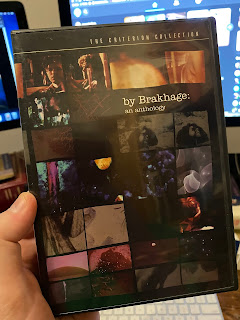
Here we have this weeks complete blind spot for me.  I ran across this in a store this last week and was very much intrigued.  The late Stan Brakhage was apparently very important in experimental film, influencing animators and music video directors and others.  I'm completely unfamiliar with his work but looking at some of his work on YouTube I'm very intrigued.  For instance, Dog Star Man, which uses various levels of superimposed imagery to a very interesting effect.  


Or Window Water Baby Moving, which is the record of the birth of his daughter Myrrena and is credited for helping to make birth less of a mystery to many Americans who saw it (and was often on a double bill with the educational film All My Babies).  CW: it's explicit as hell.


A lot of his work is available on YouTube but I can already tell from these clips that I want to see them remastered on this disc.


________________________________________


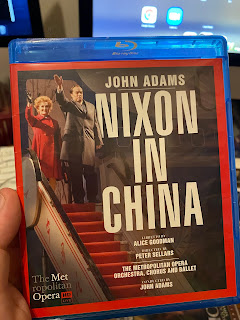
John Adams is an excellent opera composer who works in modern subjects.  In this case, the visit of President Nixon to China which resulted in closer relations between them and the USA (and also hung Tawan out to dry as they were expelled from the UN and the USA broke off formal diplomatic relations with them).  Sadly, I've not seen this filmed performance but Adams is pretty much always worth a look.


Now the one of his that I have seen multiple times is Doctor Atomic, about the last hours before the Trinity test in Los Alamos where everyone involved in the Manhattan Project is wondering if the bomb will even work or if it's going to work all too well.  It's a magnificent work of dread and wonder and has one of the greatest arias I've ever heard, as General Leslie Groves contemplates the impending explosion.  Sadly, I can't find that one, but my god check out this area by Oppenheimer.


Sadly, neither opera appears to be streaming anywhere.


________________________________________


And now, on to the heavy stuff!  Coming in 1978, this is the kind of miniseries I so loved in my childhood in the golden age of the network miniseries. I very vaguely remember seeing this as a kid without any real sort of context (to be fair, I was 5).  So I was really happy to come across this, with baby versions of James Woods a year before his breakthrough in The Onion Field, Meryl Streep a year before her first Oscar for Kramer Vs Kramer and Michael Moriarty four years before his breakthrough in Q: The Winged Serpent.*


*OK, fine, he already had a Tony by this point and won an Emmy for Holocaust. 


FIlmed in Germany and Austria, this was apparently very well-regarded at the time and won a ton of Emmys (and while they aren't the ultimate arbiter of quality, they're also not completely inconsequential).  It reminds me that I also want to check out War and Remembrance and The Winds of War, two sprawling miniseries based on very popular Herman Wouk novels that follow several families through WWII.  Sadly, those don't appear to be streaming at all but it is available on DVD.

Holocaust as well is not on streaming anywhere.  However, Q is streaming on Cinemax and on Pluto TV with ads and I cannot recommend that crazy movie enough,


Wednesday, October 20, 2021

Hitchcock Baker's Dozen: Ray Bradbury's story "The Night" -- Garbo


The last time we looked at this mystery/suspence collection, we focused on a relatively-unknown writer. This time, we've got an audio version of a story from the collection, one written by a well-known author, Ray Bradbury. 


A note on some of the lesser-known authors in this collection: I finally ended up overpaying to have my own paperback because there are a few stories I can't find anywhere. I remember when people used half.com and eBay and Amazon to sell off their personal book collections and then there was a glut and books didn't fetch enough for sellers to make a profit. The old race to the bottom. Now giant warehouses have bought all the books and warehoused them and any used book is a collectible and I pay through the nose unless I have a lucky day at a yard sale or the thrift store.  But some of these authors and their stories, better known in the 1940s when the original edition came out, have faded into obscurity and so hace the popular magazines which once printed these tales. The entire system of libraries in my state had neither this collection nor other anthologies with some of these stories. So I bought this worn paperback and feel glad I could find any version at all for some of these selctions. 


Tuesday, October 19, 2021

"Queen Christina," Part 3 of 3: More Royal Than Human -- Garbo

I begin with the reminder that these posts about Greta Garbo's films are opinions. Today's post has a lot of references to gender and sexuality. I'm not an academic in Gender Studies and I'm not a listened-to voice in terms of today's politics. I'm simply a person who watches old movies, with thoughts and feelings I want to share with anyone who's interested.

 I know there was a gap in this virutal  Garbo film festival late in the summer when I posted a few non-Garbo-movie essays on the blog. Now the series is back. At the end of this post I've given you  links to the essays that came before today's offering. You are now reading  Part 3, about one of my favorite films.

As mentioned in as earlier post about the sources for Garbo's films, the actress did a number of biopics, of which "Queen Christina" was one, obviously. And so we're given the chance to think about Hollywood versus reality. Sweden really did have a Queen Christina, whose reign began about twenty years after William Shakespeare wrote his last play. For reasons explored within this post, historians, both dedicated and casual, have argued for decades about who Christina was and how she lived.


 It isn't hard to find one theorist with a set of conclusions and then another theorist with an opposing set. I looked through a number of sites which contained some  history about the Swedish ruler's life and reign. For this post I settled on THIS ONE as the right mix of fun and easy to read but also loaded with facts and dates. If you want to know more the real Christina of Sweden, start there. 

While my wish is to set the record -- well, not straight, haha, let's see,  better start over. My wish is to challenge people who want to bring a modern sensibility to a figure who lived in the 17th century. And I also want to acknowledge the reasons that the character of Queen Christina, as played by Greta Garbo, has remained appealing to so many viewers for so many years. 


Cynical folk love the quote (usually ascribed to Oscar Levant but actually originated by Ed Gardner, who played Archie on the old-time radio show "Duffy's Tavern") "Strip away the phony tinsel of Hollywood and you'll get to the real tinsel underneath." But I'm not that cynical. Personally, I love the magic and make-believe of golden-age Hollywood. If I want hard truth, I read the news. And there are reasons why the make-believe was so good back in the 1930s and 1940s, the era in which 'Queen Christina" was written and produced.  People needed a chance to get away from it all, and Hollywood did its best to give movie-goers a means of escape. 

The film came out in 1933, and I do mean came out.  This kiss is one of Hollywood's most remarkable pre-Code moments.


The woman Christina kisses is Ebba Sparre, the real-life lady-in-waiting to the queen. While it's not clear historically that Christina was a lesbian as we would define the term today, most researchers are certain that she had romantic attachments to other women and some of her contemporaries were aware that Ebba had a sexual relationship with Sweden's ruler. More on Ebba in a moment.


Margaret Leland Goldsmith, an international finance expert who became a prolific biographer, translator, and author of historical fiction (and one-time lover of Vita "Orlando" Sackville-West), wrote a number of "psychological biographies," including Christina of Sweden, published in 1935, two years after the release of the Garbo film. 

Here's the opening for Chapter Five of Goldsmith's book Christina of Sweden:  "Most of Christina's biographers have agreed that her refusal to marry was the decisive factor in her life. And they agree that had she married, she would not have abdicated; she would have become a great ruler instead of a great adventuress."

My comment on this passage in the book:  For most women of the 17th century, marriage could provide security or it could make a woman unsafe in her own home, depending on how her husband chose to treat her. At its worst, the marriage contract could be an asset grab or lifelong servitude. At best, it could be a partnership with benefits for both parties. But in the mid-1600s, it was unlikely to be a love match chosen by both husband and wife because of passion or compatibility. Christina could just have been smart enough or so enabled by birthright and money to expand her options.  Could Christina have simply reasoned that to be a wife, one had to be a woman, so if one has the power to rename oneself as "king," then one can't be a wife? Wasn't it Golda Meir who said that women shouldn't learn typing as a backup in case they couldn't find a good job, because if you can't type they can't make you work as a typist?

But then I find valid pushback to this idea that Christina wasn't expressing herself, just outmanuevcering her opponents in this bit of dialogue from the film "Queen Christina" It's Hollywood dialogue but of interest because it's based on someone's hearing similar words in Christina's court:


 And this side of the argument is the one author Margaret Goldsmith takes. In Christina of Sweden,  Goldsmith continues on the topic of Christina's refusal to marry:

"None of them however, even serious modern writers, venture to discuss the delicate reasons prompting her to remain unmarried...Had Christina's elderly advisers suspected the intensity of her devotion to Ebba Sparre, they would have been shocked to the very depth of their Lutheran souls." The closeness of the queen and her lady-in-waiting does seem remarkable -- and obviously, it was remarked on by people at the time. The era of the "romantic friendship" between women was far into the future.


When deciding about the hitorical truth, I feel that it's important to keep in mind that biographer Margaret Goldsmith herself had experienced romantic love with another woman, after which she'd chosen to seek a divorce from her husband. Was she recognizing, in Christina's life, a familiar set of emotions, or was she seeing what she wished to see? How would any of us, including Goldsmith herself, know for sure?

The famous on-film woman-to-woman kiss was thrilling to many movie-goers in the early 1930s, I suspect the Hollywood writers knew it was sensational but they may not have seen it as the enormous shock it was to the rest of America. The scriptwriters for "Queen Christina" came from a group of European refugees, centered around actress and writer Sasha Viertal.  

I'm not sure why it is that Europe has historically been so much more tolerant of LGBT+ folk than the United States. As late as the 1980s and 1990s, we saw that across the Atlantic, society accepted gay men and lesbians in military service. Many individual nations passed marriage-equality laws without a lot of fuss. And even back in Greta Garbo's era, those who'd fled Berlin and Vienna to end up in Los Angeles had direct experience with seeing gay men forced to wear the pink triangle or sent to work camps or suffering worse fates than that. 

Of course, Hollywood doled out more tolerance to some than to others. Racism and depictions of any culture outside the WASP ideal were at horrifying and damaging levels. But compared to the rest of the U.S., Hollywood was tolerant and accepting. A surprising number of women (white women of course) and LGBT+ people worked as professionals within  the film industry. Some held positions of power when that happened nowhere else. And this, in my view, was because in entertainment as a business, it was talent that counted more than anything else, especially when we're thinking about people who worked behind the scenes.


"Queen Christina" was made just before Will Hayes created a code used to for censor movies and choose which films the public would be allowed to see. A lot of wild stuff was shown on the movie screen.  Hollywood was insular, and when you live and work in a tolerant place, you can forget how the rest of the world can be. I know this from moving from conservative Indianapolis to the liberal  college town Bloomington, an hour's drive south. When I lived in Bloomington, people used to say "If we didn't live in Bloomington, we'd have to live in Indiana." Later, when I lived in another college town -- Columbus, Ohio -- I remember the looks of astonishment some young people from very small towns in the Buckeye State wore on their faces when they arrived in the fall as college frosh. When they saw actual obvious gay and lesbian people who were, say, eating in a restaurant, they couldn't believe it.. Not just on TV! Real gay people eating a sandwich in public!! The small-town folk were goggled-eyed at first, then they got used to us. 

An even bigger divide than that between town and gown exists, of course, between the worlds of royalty and non-royalty. Any love story of Queen Christina and Ebba Sparre is complicated by the fact that  Christina was the ruler of a nation and Ebba  was her subject. Though many a romantic movie has made love between a royal and a commoner seem feasible, there's always the power difference. Though Ebba Sparre was a companion rather than a servant, someone from the nobility, who had her portrait done in oils and things like that, the convention with a lady-in-waiting was that she must always be of lower social standing than the woman she served. So while the relationship is not quite that of Arnold Schwarzenegger canoodling with the family nanny, it's not like Queen Christina's love life was with a social peer, as happens with most (if not all) humans. On the other hand, it should be noted, while the real Christine was not the lovely movie star we see when Garbo plays the queen, Ebba Sparre was apparently so gorgeous that she played the role of Venus in a mythology-based play put on at the court. So at least Ebba had some form of power that balanced things a bit. 

The subtitle of today's blog post is "More Royal Than Human," which is a reference to Part 1 of this series, subtitled "More Regal Than Royal."While I don't think royals can be called inhuman, they really do live in a way that rarely overlaps the experiences of ordinary human beings. This goes double -- or perhaps triple or quadruple -- if we are going back historically to a time when kings and queens were not figureheads and ceremonial ribbon-cutters in modern democracies, but the actual rule-makers and rule-enforcers in their lands. 
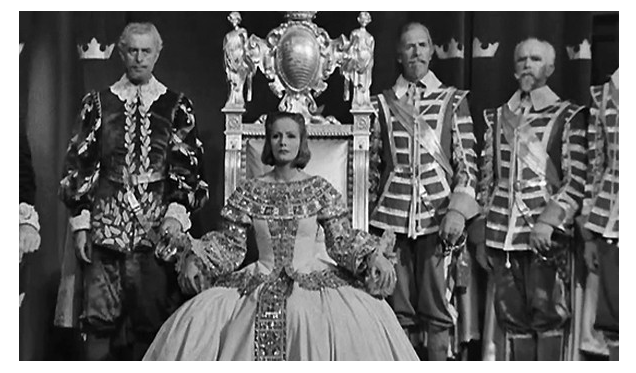

If you think about family or friends who have attended different kinds of school, it's obvious how these experiences have shaped their world views. Someone who was homeschooled had a very different childhood from someone who was sent to a math and science program and then was expected to do three hours of homework every evening. And someone sent to boarding school had yet another experience. And fifth grade was one thing to someone who went to a substandard school in a crime-filled neighborhood and something else to a child in a school filled with the latest technology, picked up after school in a van and driven to a playdate at a safe playground in a quiet neighborhood. All these individuals are children who got something called "education,"  but none of these people could really relate to the experiences of the others. That's the closest analogy I can come up with for the difference between myself, a product of an unremarkable public school in an unremarkable city, and someone of royal birth. 

Add to that going back in time to an era where European rulers had either total power or shared power with a government, and we get even more things about hereditary rulers which are not like the rest of us. For example, the "royal we." In its 1970s "Flying Circus" televsion show, Monty Python had an animated bit with Queen Victoria "talking" and she'd say "We are not amused" at the end of a comedy bit. 


Referring to oneself in the third-person does sound weird. But Queen Victoria did it as an ackowledgement that she was not  single individuals but representatives of the State.  Saying "we" was not to make herself more important, but to express that she had more responsibility than a commoner had. 

When I chose the subtitle "More Royal Than Human" for today's post, I didn't mean that a king or queen is inhuman like a robot or a criminal but in the "royal we" sense of Queen Victoria. Christina of Sweden, like other European rulers was considered to be less like a single human being and more like a functional unit of a larger machine. An individual person has more room for self-expression and may be allowed to develop naturally from their own wishes and hopes, but a representative of the State may need to become what the State needs. 

This idea is not unfamiliar to me personally. I grew up among the working poor, for whom household responsibilities were like the duties a ruler-by-inheritance owe an entire nation. In the families I grew up around, the fathers often did work which was dangerous and injurious to their health. In high school I knew a lot of boys who were promoted to manhood when the father died or if the workload was too heavy for the adults. in my own mother's Appalachian culture, there was a tradition of the "Big Girl," who was a daughter promoted to the mother's assistant.

When kings and queens rules nations, a member of a royal family was less a person and more a walking representation of the state. As a representative, a daughter may be called on to become a son. It's a bit like the roles of male actors in ancient Greece who were called upon to play female roles. Women were not allowed to appear on the stage, so for the good of theatre, men needed to step up and play the female roles. 


Much more bizarre roles were played out in royal courts of medieval times. In order to create bonds between nations, a male infant in one country was betrothed or married to a female infant in another nation, and then advisors to each baby did the actual rulership. And we certainly can look at British history, from ancient to modern, to find examples of gay kings who were theoretically married to women chosen by their families. It wasn't just gay men who had fake marriages. Male consorts sometimes sat next to their wives (and sovereigns) at public events, acting the role of husband, but then hours later they didn't have access to the current queen's private chambers. And royals often didn't choose who they married; Prince Charles never wanted to marry Diana -- he wanted Camilla, but his mother wouldn't allow him to remain single and happy with his married girlfriend.

Which brings us to the idealized view of Queen Christina, as played by Garbo in the movies, as a free spirit, doing as her heart told her to. Of course Christina is supposed to be exceptional, but members of the royalty have many more obligations and fewer freedoms than the people they rule.


What people think of you, whether or not you were born to rule, makes a difference in what you have to have to be free. You need position, allies, and money if you hav e to defend yourself from those who would limit your personal freedoms.  Pilot and speedboat champion Jo Carstairs had her own island. 


So far we've spent time in a consideration of who the actual Queen Christina was and what we believe or accept about her. Now to that, we add some modern recent cultural history to actress Greta Garbo, who seemed very androgynous or masculine to some people at the time, and who still has that vibe now for modern viewers. 

The same physique which makes Garbo look so glamorous  in evening gowns also made her a natural for the boyish fashions from the age of the flapper. Garbo was a star in Europe and then America during the film industry's silent era and costume designers made the most of the star's long slim torso. 


When we think about the flapper, what we get to pretty quickly is physical freedom. Of course there was psychological freedom and release from social expectations. Instead of completing a limited educational program and waiting at home with her hope chest and trousseau for someone to come purchase her, the wild girl of the jazz age had enthusiasm for life. She needed a body freed up for dancing and climbing in and out of roadsters and bedroom windows. What a change from the Victorian and Edwardian eras! And that sense of self-freedom was Greta Garbo all the way. She was not only naturally athletic but Scandinavian and outdoor sports like skiing had always been part of her life. 

It's easy to think, that because Garbo looked so good in masculine or boyish attire that this said something about her personally. There's much more speculation about Garbo's love life for a century, and how the hell really knows the heart of any specific human being, famous or not? We tend to associate butch women with lesbianism, but what that really used to mean is that women with short hair, tailored clothes, etc. were in a position to express themselves openly. They were either daring rebels or they were well-to-do or socially prominent. Take for example, Vita Sackville-West, mentioned earlier in this post as author Margaret Goldsmith's one-time lover.

Sackville-West was married to a husband with a title, and the couple had a separate-lives arrangement. Novelist Virginia Woolf, who was also married, was widely believed to be one of Sackville-West's lovers, and she used Vita as a model for her character Orlando. 


Add to this the Hollywood publicity machine. Garbo's contemporary Marlene Dietrich was marketed by her manager to exude sex appeal to female movie-goers. Much secret swooning occurred.


The same thing happened with Garbo. There are many publicity stills of Garbo in films, especially "Queen Christina," which feature masculine dress and hairstyle. Note the slicked-back hair in this shot. 


Another memorable visual is the tavern scene in which Garbo is with two companion.  They're dressed like The Three Musketeers. Garbo's got a cool hat.


And in this publicity still, Garbo's got another  cool hat. 


I've seen a number of online essays speculating that Queen Christina was transgender. I recognize the fact that many young trans kids will correct pronouns used for them ("I am a boy, not a girl" or the other way around) and that they will seek out clothing and possessions which match the person they recognize inside themselves. So Christina, in history and on film, using the terms "king" and "bachelor" sort of match that, as do the choices of outfits which were traditionally worn by active men. And then we see Greta Garbo in several masculine costumes and the trans label seems to fit. 


But if we watch all of "Queen Christina," we  note that the queen wears a wide variety of outfits in the film. I don't want to confuse the film with real life, but since we don't have lots of portraits of Christina, we may have to go with the Hollywood version as a rough guide. True, in the filn Christina wears trousers at a time when most female persons didn't do so, but the outfit in the publicity shot above is a disguise. It's similar to the costumes worn by Tony Curtis and Jack Lemmon in "Some Like It Hot," or the suit and fedora worn by Katharine Hepburn in "Sylvia Scarlett," for the same reasons. 


The characters are traveling and avoiding detection by pretending to be a very, very different person. And of course while the escaping musicians in "Hot" are safer from mobsters when dressed in female attire, it's only because they are sharing a train car with an "all-girl" orchestra. If it was just the two of them, they'd be as unsafe as Sylvia Scarlett would have been traveling with her usual hairstyle and clothing. 

It wouldn't have been safe for either Queen Christina or Greta Garbo to openly acknowledge, but much live openly, as a lesbian. If Christina would have even known what that was. (I didn't until I was late in my teens, and I was born more than three hundred years after the Swedish monarch.) There was a time when a butch-femme model was better understood by the world than two people expressing gender in the same manner. So if Christina of Sweden found herself in love with Ebba Sparre, might she not have thought "Well, one of us has to be the boy, and I'm closer to that"? I'm not saying that Christina was not trans, as how would I know? I'm just saying you can't tell from a disguise an actress wears in a Hollywood movie or from fragmented 17th century historical records. 

Of course these disguises made for excellent material for movie publicity, where we are back to the kind of selling to the public that Dietrich's manager did. Gender-bending always catches the viewer's eye.

Let's consider looking again at a very different Garbo, this time in one of her early films, a silent picture in which she plays a former peasant girl who has become a celebrated opera diva:


Is Garbo more or less herself in this role? She was a movie star by this time, so wasn't she more like this glamorous figure than she was like the girl king of Sweden? Also was from a humble background, a former shopgirl turned department store model who became a celebrity dressed in fabulous costumes. 

I would argue that Garbo herself wasn't any more Queen Christina in a falconer's outfit or broad-brimmed hat than male Greek actors were when playing female roles, as depicted in those Greek actor figurines we saw earlier. She wasn't an opera diva, either, or a ballerina, or Napoleon's mistress, or the pair of twins she played in her last film role. She was an actress, and she became what the director needed her to be. 

 In making these points about "Queen Christina," I wouldn't dream of trying to take the fun and excitement out of the film. We all need folk heroes and heroines. I love seeing Robin Hood and his crew partying hearty after robbing a greedy baron and sharing the wealth with the poor, even though the historical record is, um, a bit different. The same with Garbo's version of Queen Christina, who reminds me, in her psychological, emotional, and physical freedom of speedboat racer Jo Carstairs, who was rich enough to own her own island in the Bahamas and do just as she liked.

The wonderful thing about the movies is that each of us can look at a film character and see ourselves or a self we wish to be. And that's okay, as long as we don't try to tell other viewers what they see. And the movies kindly stay the same (except perhaps for colorization) while we evolve so we can find new connections between ourselves and an on-screen persona.  When I was young I found Garbo's Swedish queen-king an inspiration in her daring. And I find the film character's honesty and clarity inspiring these days when adventure is mostly behind me but I find the need for greater and greater freedom of mind and spirit. 

 As a treat, let's finish today's post with the trailer for the film version of "Orlando," with Tilda Swinton playing the lead role. 


Next week:  Greta Garbo and John Gilbert in "Queen Christina" and other movies


FINDING THE REST OF THIS BLOG SEIRES ON "QUEEN CHRISTINA":

 I began this series last summer with two posts:

                         the very first one   and   the essay which came next

After a two-part overview on the sources for each script, we went back to the beginning and looked at the films in detail, sometimes in groups and sometimes singly. We did this first with the silent films and then moved on to consider sound films in a bit more depth. 

"Queen Christina" is such a culturally complex film that I've needed three posts (well twelve posts probably but we'll settle for three) to give the movie the attention it deserves. And actually there've been more than three posts, as there's a significant section on "Queen Christina" in the second half of the two-part series I mentioned above, the one about where Greta Garbo's movies came from.

The post on the sources of Garbo's sound films including "Queen Christina" is from June 15, 2021 and is found HERE

Part 1 of the "Queen Christina" three-parter was posted on Aug. 31, 2020. It's called   "Queen Christina: More Regal Than Royal" 

Part 2 of my consideration "Queen Christina" concentrates on the visuals in the film and has lots of stills and publicity shots. That part appeared on the blog on Sept. 7, 2020 and is found HERE

And what you're reading now is Part 3 of 3 on "Queen Christina."


Garbo