Happy Thursday, everyone! It's opening day of baseball here in the States and this week is gonna be a short one because, well, I'm moving in a few weeks and packing sucks.
______________________________________
Seven writers each take a day of the week to say something. Currently a few authors rotate to post on Wednesday.
Happy Thursday, everyone! It's opening day of baseball here in the States and this week is gonna be a short one because, well, I'm moving in a few weeks and packing sucks.
______________________________________
The newest installment of my ongoing suspense story set in modern-day Indianapolis. Audio story with slideshow.
Miss the previous episodes? START HERE
Since his first movie was released in 1925, Alfred Hitchcock used literary sources for his film scripts, of course, but it wasn't until the late 1940s that he became part of a lucrative publishing venture. After the war, anthologies of judged fiction had become popular -- The Best American Short Stories and the O. Henry Prize Winners series, for instance. Hitchcock was listed as a judge or editor for a couple of anthologies, though most people doubt the director played any part in the actual selecting of stories. The earliest such collection had an unremarkable cover and title.
The next collection,which came in 1947 and was called Alfred Hitchcock's Fireside Book of Suspense had a somewhat more colorful front cover. . .
. . .but it was the back cover which was of real interest.
Once we look closely at Farley Granger's book in this early scene in 'Strangers on a Train," we see Hitchcock's head shot on the back of the dust cover. This is one of the director's two cameos in the film.
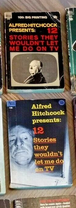
This original little spate of anthologies with Hitchcock's name on the cover ended, but ten years later, when Alfred Hitchcock came into our homes via television, there was a new phase. Mystery and suspense stories were gathered, 12 or 13 at a time, and published with titles which began Alfred Hitchcock's... There were as many as sixty of these paperbacks. And the cover art collection has expanded over time to include some reprints, often with different cover designs, which entered the publishing market. For example, this close-up photo from a lot of old paperbacks for an online auction shows the same book with two different covers:
Obviously, Hitchcock moved to the United States to make his big-budget films and stayed on to do television, but he was British. His fans in the U.K. bought paperback anthologies put out by by Pan, a company which had some similarities to the American publisher Dell.
I took an interest in these Hitchcock books last year, during a search for a short story by a slightly-obscure author, and could find the tale in one volume: one of the the many Dell paperbacks with Alfred Hitchcock's face and likeness on the cover. I discovered, to my surprise, that some of these collections had some pretty good fiction in them. And those titles and covers -- wow!
This week and for the next week or two I thought I'd share some of the cover art from these books, which were published from 1957 till well into the 1970s, with some later spin-off series coming out in the 1980s.
This time, I'll focus a few paperbacks with covers/titles which are parodies or commentaries on specific moments in pop culture:
The film "I Am Curious (Yellow)" became I Am Curious (Bloody).
A saying from a comic strip dialogue balloon turned dark pretty fast.
The popularity of the Broadway smash hit / hit film "My Fair Lady" with its singable musical score inspired Get Me To the Wake On Time.
Here's a story collection which would not be ignored.
The last pop-culture example for today might be lost on many people, but the references in title and cover image are to the 1927 Yankees.
Next week: More book covers!
by whiteray
We’re ducking back into 1970 today, back to a memory that’s popped up a few times over the years and managed to pop up again recently when my iPod offered me a certain track. Here’s something I wrote about that track and that memory a few years ago:
Wherever I might have looked for a history lesson in 1970, my pal Rick’s turntable was a pretty unlikely choice. But one day or evening during the summer of that year, he and I were hanging out in his room. He’d taken over half the basement of his family’s home and turned it into what was essentially a crash pad: a mattress on the floor, a stereo, brick-and-board shelves filled with LPs, posters on the walls, an old wardrobe for his clothes, and a lava lamp.
We spent a lot of time down there during the last years of the 1960s and the early years of the 1970s, listening to tunes and making our minds up about the things that really mattered in life; those topics ranged from the importance of the then-burgeoning environmental movement to the likely identity of the Toronto Maples Leafs goalie during the next NHL season.
But as diverse as our topics were, I wasn’t quite prepared for what I heard when Rick played Neil Diamond’s Tap Root Manuscript. The fourth track on Side One, “Done Too Soon,” grabbed me and – at the same time – provided a little bit of a history lesson:
Jesus Christ,
Fanny Brice.
Wolfie Mozart and
Humphrey Bogart and
Genghis Khan and
On to H. G. Wells.
Ho Chi Minh, Gunga Din,
Henry Luce and
John Wilkes Booth
And Alexanders
King and Graham
Bell.
Rama Krishna, Mama Whistler,
Patrice Lumumba
and Russ Columbo.
Karl and Chico
Marx,
Albert Camus.
E. A. Poe, Henri
Rousseau,
Sholom Aleichem
and Caryl Chessman.
Alan Freed and
Buster Keaton too.
And each one these
Has one thing to
share:
They have sweated
beneath the same sun,
Looked up in wonder
at the same moon,
And wept when it
was all done
For bein’ done too
soon.
For bein’ done too soon.
For bein’ done.
I was fascinated, and we listened to it again until I was certain I had all the names right. I knew all but two of them. I was unfamiliar with the name of American actor and singer Russ Columbo and with that of Alexander King. (There are two men by that name to whom I think Diamond could have been referring. One is a writer, the other a scientist. I still have no idea which one he meant to name-check.)
I’ll admit that I wasn’t entirely clear at the time why some of those men whom Diamond mentioned were prominent: For example, I knew Patrice Lumumba was African, but I didn’t know that he’d been the prime minister of the Republic of the Congo for a brief time in 1960 before being overthrown in a coup.
There were a few others where my data banks were slender as well: death row inmate Caryl Chessman, author Albert Camus and deejay Alan Freed were persons whose names I recognized without knowing why they were famous. I was also a bit uncertain about writer Sholom Aleichem and artist Henri Rousseau. And, of course, being a good sixteen-year-old Midwest Lutheran, I had no idea that Rama Krishna was, as Wikipedia notes, a famous Indian mystic of the nineteenth century.
I won’t say I ran out and began to find out about those men during that summer of 1970. But as time moved and on one occasion or another I learned why those men were famous, I’d make the connection to Diamond’s song and nod with a bit of private satisfaction.
And from that first hearing in Rick’s crash pad, “Done Too Soon” has been one of my favorites. Rick and I were fortunate enough at the end of that summer to hear Diamond perform the song in concert at the Minnesota State Fair. In fact, we heard it twice. We were in the open-air grandstand for Diamond’s first show of the evening, and then went back to wandering around the fair until it was time to meet my folks near the grandstand. We could hear Diamond performing his second show as we waited, and just before my folks showed up, we heard “Done Too Soon” one more time.
My diary is not interesting, and I need writing prompts. I'm imagining how fun it would be to have the typewriter pictured above dole them out, and that might make a good story, but... I lack the time to fiddle with a story like that. So, today, I'm going to write random things"
In the mornings I pack my car with my work bag which usually has student papers that I did NOT grade the night before. "School, not tonight!" I take my water bottle and coffee out and set them in the cup holder and console thing, and then go back in the house and adjust the thermostat and turn off the lights and lock the door. I let the car warm up while I figure out if I want to hear a podcast or an audiobook, and set off. Usually it's dark and I creep up to the main road, avoiding rabbits. This is my favorite time of day, driving along in the predawn, having coffee and contemplating things or listening to someone else tell a story.
A memory stuck in my head is looking at a cut on my hand, about two inches long. I'm holding my hand up while being the passenger in a car driving through Kansas. it's healing. It is summer and hot and the windows are down. My teenager is listening to a Metallica tape, it fits the landscape. The sun is out and the wind is blowing in and Kansas is flying by and my hand is framed in the window. I remember remembering the broken soda bottle in the crate that left this cut, and my shirt cuff is dark blue.
Bachelors buttons used to grow in the alleys of south St. Louis. They smell really good, a scent which I can only describe as a dusty blue smell. I'd walk in the alley sometimes, to go to friends' houses, or just to walk. I'd pick those flowers and bring them to my room. Near our house on Christy I would walk around the neighborhood and imagine the little taverns being mine, but turning them into something else. I like the word tavern, and they can be nice to visit, especially now that they are smoke free. I remember that Mary Hopkins song would pop into my head, sometimes. It seemed to have an effect on me as a kid, though I didn't know why. Maybe the unusual, to me, instruments. Songs are funny that way, and I'd like to take the time to really explore why some songs could just wallop you, somehow. Here's the link.
I recall a summer camp experience. I did go to camp a few times as a kid, a week long girl scout or campfire girl camp, and one particular time probably in my 4th grade year, I had a very strong experience. We had cabins with maybe 8 girls and a counselor or two, it seems. Regimented activities. I recall this girl named Adair, and she and I immediately hated each other. Did this ever happen to you? I remember the drama being mostly in my head, but I did want to punch Adair. When my mom came to pick me up, my baby brother had learned to walk that week I was away. I still get a smirk on my face whenever I hear the name Adair.
~Dorothy Dolores
There are so many. They appear in paint, print, sculpture & ink. There are famous ones, Old Master ones, obscure ones & extremely odd ones. I embarked on a “100 Still Lifes” list on Facebook this year (up to the high 80s now!) & in all honesty, I’m going to have to really restrict it to the hundred, otherwise it could become an all-consuming frenzy of making sure I get a different artist every day & attribution or provenance-checking nightmare. Believe it or not, the information given on the internet isn’t always reliable! It could probably go on all year but I don’t think that’d be healthy. My dreams are boring enough without dreaming about bowls of fruit or vases of pansies.
Now that sounds as if I don’t like them, but it’s actually a joy to find such variety. I’m not saying I’ll go for a hundred still lifes here (you endured enough with weeks of the hundred artists…) but I thought if I numbered the entries, I could probably get away with leaving it open-ended. Maybe even we’d go past the ton. We can but dream.
In any case, the still life serves many a purpose including decoration, studies & practice for the artist, a chance for the artist to show off their skills & general aesthetic appeal. It’s a nonsense that I haven’t addressed them in over two years of blog-writing, but we can make up for that now.
Adjunct: making lists of anything (particularly music, art & things that annoy me) on Facebook is one of my favourite pastimes; it’s a safe & easy activity for someone that makes many bus journeys. Unless the bus is going through Drumoak. Drumoak is a cyber black hole & your phone might alarmingly go on the blink without warning. You experience a millisecond of panic, then realise you’re in Drumoak. You immediately calm down & wait a mile or two.
Pedro Pedro (b. 1986), Bowl of Citrus, 2020
The absolute antithesis of a stuffy & staid still life, I do feel like I can smell the lemon in this image. For although the painting isn’t concerned with realism, it’s incredibly evocative in colour, texture, atmosphere & composition. Making a subject believable or authentic without being realistic is at the very heart of much art & is equally valid to the showing off of super realism.
Antoine Vollon (1833-1900), Mound of Butter, 1875/1885
Perhaps the strangest still life I’ve ever seen & certainly one of the more amusing, whilst being extremely well-executed. Get this wrong & you’re looking for a severe mocking. But does it maybe give us a clue as to the value of butter at the time of painting? Or is it about how hard someone had to work to make such a huge amount? I love that the eggs give it some scale…provided they’re not ostrich eggs, of course.
Claes Oldenburg (b. 1929), Shelf Life Number 12, 2016-2017
When does a sculpture become a still life? When the artist names it, I suppose; it’s indicative of the importance of titles. Here, the artist uses said title as a play on his age & longevity in the art world & everyday junk is given a new lease of life in the process.
Cornelis Norbertus Gysbrechts (c. 1660–1683), Trompe-l'œil, c. 1680
Everyone has to have a system for organising their lives these days & it seems the 17th Century was no different. Since it hangs on the wall, it may well have the ability to “fool the eye” & the realism is spectacular. Effectively, Gysbrechts creates a stunning portrayal of what we can assume was the iPhone of its day (other organising systems are available).
M.C. Escher (1898-1972), Still Life & Street, 1937
Again, we see the “believable” rendered in an artist’s very distinctive style. At first, it’s as if Escher has set up his still life before a window looking out into the street with this woodcut but look more carefully & we see the cunning old devil is up to his usual “impossible reality” tricks. In fact, he bursts through the building into the street, as the books rest against the buildings.
Patrick Caulfield (1936-2005), Bowl & Fruit, 1979
Caulfield minimises the still life to its basic elements: line, shape & colour. Yet the composition is perhaps the most important element, for if it wasn’t for the lines denoting the cloth behind, we’d simply be looking at a collection of objects floating in space. What it does though is remind us of every still life we’ve seen before. We expect to see that cloth hanging behind & so we know what we’re meant to be looking at. If not for the History of Art, we wouldn’t have this painting & Caulfield captures the lot.
Holly Coulis (b. 1968), Small Cup and Steam, 2019
This subverts the still life into a piece of graphic art. Again, it takes the well-known elements & subjects of the still life as a genre & plays around with them to create a work that has decorative appeal as well as clever composition.
Rembrandt van Rijn (1606-1669), Conus Marmoreus, 1650
The objects Rembrandt amassed in the name of art are legendary & at one of the houses he lived in – now a museum – in Amsterdam, replicas are exhibited for all to see. Rembrandt was like many of us – he liked collecting junk. Obviously he’d use them for reference in his paintings but why stick to just one petrified pufferfish when ten will do? I exaggerate of course. Yet, only twenty-two books were found when he died…
Salvador Dalí (1904-1989), Still Life, 1918
Although this is an unusual Dalí, we can still see his style shine through. Despite his youth, he is almost fully-formed as a painter, albeit pre-Surrealist movement.
Ken Currie (b.1960), Heavily Symbolic Still Life, 2009
A still life collection without a skull is no collection at all & here Currie evokes the Vanitas still life paintings of old. With two of the most evocative & widely-used symbols of mortality in everyday culture - not just the Old Masters - & Currie’s distinctive style, this is modern still life at its finest.
I've only rarely done April Fools jokes, and I'm not intending to do any here. I've never really approved of them, as so often they reduce to "Ha ha! What a moron! You trusted me!" Not the message I want to be associated with. If I ever mislead you here it's going to be a matter of taste, or an accident, not of sniggering design. So, enough of that.
Today on Netflix, we have an ensemble comedy about a group of actors confined during COVID-19 lock-down in a hotel, where they're trying to complete the 6th film in a flying dinosaur, action movie, franchise. Judd Apatow directs and stars with a cast that includes Karen Gillan, David Duchovny, Keegan-Michael Key, Kate McKinnon, Pedro Pascal, Fred Armison and Peter Serafinowicz: It's The Bubble (2022 R for language, sexual content, drug use and some violence 126m)
The screenplay was inspired by the situation the actors went through during the making of Jurassic World Dominion
(2022). Pandemic protocols found them all living in, and essentially
confined to, the same hotel. As this comedy includes elements of a film
within a film, they took advantage of that to initially release an arch
teaser for the fictional film (Cliff Beasts 6: The Battle For Everest) back in early March... before revealing the name of the actual comedy film they've made.
While
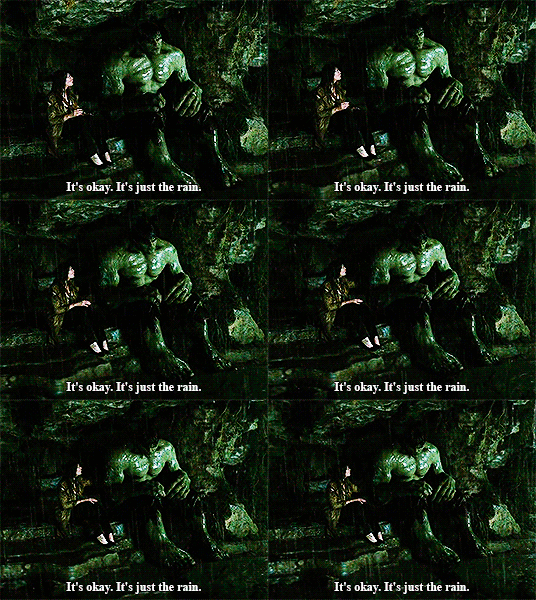
nothing remotely new - fourteen years old, in fact - I took note that
arriving today on HBO Max is one of the first official Marvel Studios
movies, The Incredible Hulk (2008), which hasn't been streaming
(sans commercials) anywhere I'm subscribed to. It'll be nice to have
access to it again after all this time. (There's a persistent tangle due
to an agreement made with Universal back in the '70s that complicates
all big screen things titled "Hulk", which is why this may never make
its way to Disney+, and why multiple, likely, Hulk-centered projects
aren't likely to be coming to the big screen as such. I can tell anyone
interested in some detail, but I'm not going to get into it here.)
That
year they knocked out the first two films in what would become an
entertainment franchise juggernaut, and we really weren't at all sure
what they were going to get right and what they weren't. Honestly, they
weren't at all sure either, including what the audience would respond
well to, and how much detail they'd be looking to absorb. Sure, the
comics fans generally live on the details, but even now we're relatively
few. They weren't even sure they'd be able to hook a
fiscally-significant audience, as the vast majority of mainstreamers
didn't know Iron Man, much less Tony Stark, as we entered 2008, and the
only Hulk those people were aware of were those who were old enough to
remember the late '70s/early '80s tv movies and shows, and maybe Ang
Lee's, underexposed, 2003, almost-nature film.
It was fun to revisit that after all these years, seeing how they were feeling their way through the process. I'd somehow forgotten the much-appreciated at the time touch of allowing the origin to be treated via some flashback scenes and a brief bit of exposition, rather than pulling a DC and thinking they had to ponderously reintroduce the main characters and reshoot the origin arc.
I'm almost at the stage where I might go back to rewatch Hulk (2003) - mainly to refresh myself on a few specifics, just for the hell of it. At the time I was mainly happy to see it even just in finally getting a Hulk at an appropriate power level.