Saturday, November 13, 2021

Scotland in Art: Townscapes - Esther

Scotland has seven cities & including these, fifty-one localities with a population of over fifteen thousand. Naturally, there are more townscapes from Scotland depicting more built-up areas such as the cities, particularly the capital Edinburgh & largest city Glasgow. But there are all kinds of settlements, including very small, rural areas. Sometimes these become a key part of the landscape, despite having residential features & the world of art portrays this too. 

In 2019, the lowest birth rate since 1855 was recorded in Scotland, whilst immigration to Scotland especially from other European countries & including those studying here has increased. So year on year we see constant construction taking place in our towns & cities as more flats & houses continue to be built & the population’s changing needs evolve. Whether or not many of these newer builds will inspire the townscape art of the future remains to be seen…


View From the Mound, Edinburgh, Looking West (c. 1929), William Crozier (1893-1930)

What I like about Crozier’s painting is his depiction of the clear development of the built-up area around what the landscape offers. Edinburgh Castle sits atop the enormous Castle Rock, the plug of an extinct volcano which rose up around 350 million years ago. Crozier effectively records the pre-history of the area whilst capturing the ingenuity of people from as early as the Iron Age to inhabit the area & later build the fortress castle & a capital city on & nearby such unforgiving terrain. Walking the streets & hills of central Edinburgh, you are constantly reminded of the past & the geology you are navigating.


Catterline in Winter (1963), Joan Eardley (1921-1963) 

From the capital to a village, there is nevertheless evidence of Bronze Age activity in Catterline. Often focusing on the coastal aspects & seascapes, here Eardley walks us up the rough road towards the tiny settlement. The scene will be familiar to anyone living in NE Scotland in the winter – the slate sky sparely lit by the weak yellow moon & the isolation that heavy snowfall can bring to rural communities.


Windows In the West  (1993), Avril Paton (1941-)

This is a well-known & much-used image in Scotland. Partly, I think because if you’ve ever taken a wander through Glasgow, it’s a very familiar site. As well as the style of the tenement, the pinky sky is typical of a Scottish sky after a snowstorm. The building material is also recognisable - Glasgow is to sandstone what Aberdeen is to granite. This appears to be what’s called blonde sandstone but much of Glasgow is made with red sandstone. In any case, the windows reveal much human activity behind them & we feel a voyeuristic connection as we watch the figures go about their business, knowing that they could just as easily see us. 


Kelvingrove Park (2000), Alexander Goudie (1933-2004)

Kelvingrove Art Gallery & Museum is red sandstone however, although you can’t tell that from this image. Scotland is great at creating very grand buildings & housing objects in them. Every city & many towns have museums & galleries & where would we be without them? In this piece (which I fortunately got to see recently before it disappears into a private collection), we view the looming building from below; we’re surrounded by brush & bushes. It’s a very unusual aspect but it gives a sense of the enormity & grandeur of the building beyond. It’s as if we’re approaching greatness ahead of us & it creates a tension through this suspense.


The Sensation of Crossing the Street – West End, Edinburgh (1913), Stanley Cursiter (1887-1976)

It could be any busy city & is perhaps not strictly a townscape but this work still effectively relays the sense of movement, stress & rush found in many an urban setting. Crossing the road is still much like this, even with the many traffic-calming measures now included in all Scottish towns & cities.


George Square & Charlotte Square From My Studio (1909), Francis Cadell (1883-1937)

I confess, I’m not saying this is the most remarkable Scottish townscape ever painted, despite Cadell’s genius, but I am desperate to share its story. It’s best told here: 

https://www.bbc.co.uk/news/uk-scotland-edinburgh-east-fife-31000264

It does make one wonder what Denis Peploe - a wonderful artist himself – was thinking…


Stobo Kirk (1939), James McIntosh Patrick (1907-1998)

This is one of several paintings of Stobo Kirk created by Patrick but I like this because of the muted colours, vertical composition & realistically threatening sky. Although it appears remote, there is a small settlement nearby (situated near Peebles, several miles from Edinburgh) & there has been a church here since the 6th Century. Kirks like these often form a focus for small communities, particularly in the past.


Design for Scotland Street School (1906), Charles Rennie Mackintosh (1868-1928)

Today, Scotland Street School is a museum but following its opening, the children of primarily shipbuilding & engineering workers attended. As a school, it closed in 1979 & was CRM’s final significant commission in Glasgow.


New Aberdeen (c. 1807), Alexander Nasmyth (1758-1840)

One of a commissioned pair (the other predictably called Old Aberdeen), Nasmyth based the works on watercolours by Aberdeen artist Robert Seaton. It clearly shows how a town like ours was (& to an extent still is) simultaneously dependant on & constrained by its nearby rivers.


Inverness from across the River Ness - Sketch & watercolour (1833), Joseph Mallord William Turner (1775-1851)

I just find it bizarre that Turner ever painted Inverness, but here’s the proof. This view shows the west bank of the River Ness towards Ness Bridge. This bridge was destroyed by flooding in 1849. Also included are the Tollbooth & Old High Kirk.


The Old Town, Edinburgh (Crescent Moon) (2019?), Clive Ramage (?)

Despite the naivety of style & colour, the composition of Ramage’s Edinburgh is really not that far off. As we’ve seen, because of the basic structure of the city (volcano, geology, etc), in certain locations & from certain positions, Edinburgh does have this layering effect & a distinct feeling of upward movement in a visual sense.


Around the Twist (2017), John Glynn (1964-)

Inspired by the area around Whitehills harbour in NE Scotland, I do love this clever composition - it lends this townscape a universal quality. In all harbour areas, regardless of town, country or continent, you’re bound to find cats – this is also true of John Glynn’s works. There is always a cat & you have to find him. 


Friday, November 12, 2021

The Unreal and the Real - Nov 12 - Friday Video Distractions with Mike Norton


  November 12th! Another, generally standard week coming up, with the following one (at least here in the States) rolling into Thanksgiving and the more or less formal start of the end-of-year holiday block. At least that's how it's divided in my mind. Still, that's much more a topic for next week.

    An expensive final quarter of the year for me includes a substantial hit on my emergency fund. A transmission's being built to get my car back on the road, the not inexpensive rental car is also in the mix, all the more so as there is a roughly two week wait on the transmission. Looking forward to better days, I remind myself that it's at least good to have an emergency fund in place; I've been in similar straits before without one, and that's a bad, sad place to be. Still, the speculative accounting for getting me back on the road in my own car's already at a ghastly level -- which I'm telling myself that if I get through this without it going higher I should accept it, gracefully, as a victory. Should.
     On the momentary plus side, I (technically) have the day off, and I've already made today's dinner (beef stew, developing slowly in a crock pot) a couple hours before dawn. A gray, damp day outside, I'm fine with the idea of staying put.
     Quick note: Given all the wonderful films the channel shows it seems appalling to shine this particular spotlight, but I'll mention that the box office and critical bomb Skidoo (1968) is scheduled to air 2AM Saturday on Turner Classic Movies.
     I did a full piece on it back in February 2020, while we were still in the first half year of the Consortium of Seven, which includes a link near the end to a very nice copy over on YouTube -- which I see is still there. As I went on about at some length then, it's almost entirely of interest only for the parade of familiar faces (mostly to those of us on the high side of 50), and how & why the film was made. It's a very particular brand of bad, dated movie that's much more fun to be familiar with than to, well, watch.
     Moving on...
     Disney+ is celebrating their second anniversary - the streamer launched on this date in 2019 - by, among other things, offering a month of their service for $1.99. Today they've also added new content, including having 2021 theatrical releases Shang Chi and the Legend of the Ten Rings, and Jungle Cruise now available - the former had been theatrical release only, while the latter had been one of the last of the items that was behind a separate pay wall. As it's the anniversary, and we're nearing the end-of-year holidays run, they're looking to add new subscribers and get as many existing ones to stay, so as we roll into the extended Thanksgiving weekend in less than two weeks we'll see the launch of the next Marvel series, Hawkeye, and the debut of the multi-part Beatles documentary from Peter Jackson, Beatles: Get Back. (Specifics and trailers on both of those next week.) A one-month buy-in for the service would give someone access to all that's already in place on the service, and would allow them to see all of the Beatles doc (released in three, daily, parts on the 25th, 26th and 27th), but would just get one part of the way through the Hawkeye series, being released weekly.
     This Sunday (the 14th) Paramount+ will begin a 10-episode first season of a crime thriller series. Mayor of Kingstown centers on the McLusky family, power brokers in Kingston, Michigan, where incarceration is arguably the only thriving industry. Stars Jeremy Renner, Dianne Wiest, and Kyle Chandler.
     Plenty of themes to track, among them corruption, inequality and systemic racism, it'll be interesting to see if they have something useful to say.
     
Between this and Disney+'s Hawkeye, Renner is starring in two series launching this month, btw.
     Arrived on Netflix this week is another action film (they're piling up) that's not of immediate interest to me, but I know the formula's a comfort for some, and comfort's a big part of the whole streaming entertainment game. In Seized (2020  85m) a former Special Forces operative (aren't we all by now?) finds himself pressed into an unwanted mission against three crime syndicates as ransom for his son. It's the sort of premise one will quickly not be able to remember if it's for a film or a video game. Starring Brit martial artist Scott Adkins, and by Israeli director Isaac Florentine (and I am not pretending I knew either of these names fifteen minutes ago), here's the trailer.
     Again, not what floats my particular boat, but I know people who might munch this like a tub of popcorn.
     While on both Netflix and recently-arrived action films, we have the action-comedy, buddy/caper film Red Notice (2021, PG-13  h1 58m), which has just appeared today. Formulaic? To be sure, but with Dwayne Johnson, Ryan Reynolds and Gal Gadot as the leads there's no shortage of attractive people to root for, and quick movements to engage that kittenish part of our brains looking for dangly, twitchy bits of string.
         Also recently-arrived on Netflix is season one of a hoarding-adjacent reality show - Swap Shop. Loosely spinning out from the Tennessee-based radio show World Famous Swap Shop (on the air in some form since 1954, connecting buyers and sellers), it focuses on people whose business is hunting down (ideally) rare items to buy, sometimes restore, and ultimately to flip for a profit. The line between avocation and business is often blurry, and it's easy to see how in some cases any potential profits are much more than eaten up by the effort and materials involved. Still, if it keeps them busy and happy, and mostly pays for itself, it's not a bad life to aspire to.
     The trailer is immediately reminiscent of American Pickers, and much like that show (and other buy-and-flip formulas like Pawn Stars and Storage Wars) might be a no-cost/no-space way to vicariously scratch an itch that might otherwise lead to a hoarding problem of one's own. (We get some of that relief valve here in the Consortium of Seven blog on Thursdays, when Joseph brings us his Trawling Through the Thrift Stores -- though of late it's mostly been print and video media.)
     Also, as with those other shows, we know that virtually nothing we see is spontaneous - everything's staged - but we roll with it on the relative strengths of the items of interest and the personalities involved.
   To help keep things varied, the show moves among a trio of partnerships: Tori and Larry run an antiques store in Johnson City, Jason and Bob each have businesses that auction or directly sell an eclectic mix of items, while Dale and Scott own Kyker's Extreme Automotive, finding vehicles (or pieces thereof) for restorations and rebuilds. This helps make it potentially interesting for a broader audience.
     On Hulu since late last month, but my just becoming aware of it, is a series on food, and innovations in food science, as chef David Chang brings us The Next Thing You Eat. It's a look at technology, much of which is already in play, and how it's changing food, its preparation and delivery. Six, roughly half-hour, topic-targeted episodes.
     Amazon Prime, today, sees the arrival of two documentary items, tied by a theme of representation. One is a documentary on Pete Buttigieg: Mayor Pete.
    ...the other is a four-part docuseries (all parts available immediately) about Jane Noury, a transgender teenager living in Sparta, New Jersey: Always Jane.
     Next Friday, the 19th, Amazon Prime will launch their adaptation of Robert Jordan's The Wheel of Time (series of fantasy novels) with the first three episodes. The remaining five will air weekly, concluding December 24th. Season two was given a go-ahead back in May.
     Also arriving next Friday, Netflix will premiere the live-action version of the anime Cowboy Bebop. A sci-fi noir series centered on bounty hunters in 2071 (at least that's where the 1998 anime series was set -- we'll see if they adjust that for this live action series) trying to make a living, live with themselves, and trying to stay at least a couple steps ahead of their pasts.

          John Cho is likely the most familiar face in the cast. Animation/comics/tv & film writer Christopher Yost is series writer.
     This is a 10-episode series, each running - roughly - an hour. (I'll revise that once I know better.) As this is Netflix, it'll all appear at once.
     Just ahead of that, Next Thursday (18th), Paramount+ will have the season 4 premiere of Star Trek: Discovery.
     What began as a largely Star Trek prequel series has since become the most futuristic of the franchise. (I can't be precious about "spoilers" from two seasons back.) The last episode of season three was back just in January, but it feels much longer ago than that. I'm looking forward to getting back in with the characters and their bold, new times.
     I know the filming for this season was heavily impacted by the pandemic, resulted in some rewriting, and a likely reduction of number of scenes for one or more of the characters. (Most pointedly Tig Notaro's Jett Reno, as cancer-survivor Notaro was being especially careful about exposing herself to possible infections.) As we cut through the trailer, too, I couldn't help but notice some changed faces,
which may or may not reflect radical changes in daily routine for the actors.
     On the other hand, I know this season is also the first one where an elaborate video array was built and used for filming. (This is similar to the StageCraft system used on Disney+'s The Mandalorian, so we know it's very promising. It'll also be what we'll be seeing right from the start when Star Trek: Strange New Worlds debuts sometime next year.)  A horseshoe-shaped, 70 x 30 ft, 270° array of LED video panels that project real-time backgrounds for filming, using game software Unreal Engine. Ideally it provided more of an immersive environment for the actors, where previously all of the peripheral effects had to either be constructed, "practical" ones, or saw the actors performing in front of green screens, being told what to imagine they were seeing, as those visuals were added later, elsewhere.
    
     I hope that was enough variety to find you with at least one item potentially interesting enough to check out. Looking back over even just the past few Friday entries, I still see so many things I have yet to make the time for.
     Stay safe, and let's meet back here next Friday, when we at least start to lay out the overstuffed Thanksgiving holiday weekend of possibilities to meld with the most comfortable, screen-adjacent piece of furniture you own -- and fresh batteries in your remotes.  - Mike

Thursday, November 11, 2021

Trawling Through The Thrift Stores with Joseph Finn

 Happy Thursday, everyone!  It's Veteran's Day here in the USA (and appreciation for all our veterans).  This week in thrift store finds we have a 19th century utopian novel, an American Treasure knockoff and Mark Harmon has to reflect on his life before he goes onstage!


_______________________________________


Let's start with the schlock of the week!  There's a whole run of Mummy and National Treasure knock-offs over the last 20 years and frankly, I'm here for this cast even though I bet some of them are in it for about 5 minutes.  Even better though?  Looking the plot description, this is also a knock-off of the middling Dan Brown decoding mysteries like The DaVinci Code.  And it's a 4-hour miniseries!  This might be something I toss on today to fall asleep to on my day off.  Because come on, it has thieves dressed up as Knights Templar stealing a decoder and leading everyone on some sort of adventure.


Worth noting...poor Mira Sorvino.  She has a very-well deserved Academy Award and then had her career absolutely destroyed by the Weinsteins, those sick bastards.  Thankfully, it looks like she's back in the game again with some interesting projects coming up.   But still, 20 years of potential great work lost because of them.


Sadly, The Last Templar does not appear to be streaming legally anywhere.


________________________________________


Now here's something I was completely unfamiliar with.  The story of a man hypnotized into sleep in 1887 wakes up in 2000 (I know, let's not think too hard about that), this looks to be one of those old novels that tries to picture a utopian society according to the mores of 1887.  (My personal favorite so far is that they have a version of Spotify, but because the electronic transmission of music was a few years in the future instead they have people playing live music that is transmitted to people's homes through phone tubes, a quite fun steampunk solution.).

Of course, a lot of this even flipping through is speechifying about how bad 1887 is.  It's just that kind of book.   I mean, I get it.  Even Huxley and Orwell could be prone to it in Brave New World and 1984.  It's just something you have to be aware of in a novel like this.


________________________________________


Now this is one I'm curious to revisit.  Stealing Home is a movie about a an ex-baseball player, played by Mark Harmon, who comes back to his home town to reminisce about his his career never qutie panned out like he hoped.  There's a lot of flashbacks to the late '60s and his older friend, played by Jodie Foster, who was his mentor and (in my memory) unrequited crush.  I remember it being a very lazy summer gold light sort of movie and Harmon and Foster being very good,  (It's kind of interesting to know that they are actually very close in age despite the structure of this movie, with Harmon being a year older though Foster started her acting career earlier.)


This trailer feels just slightly more wacky than I remember the movie being, but I expect the studio marketing people were trying to find some way to tie into your typical '80s sex comedy.  But then WOW I found a music video for a song from the soundtrack and maybe I don't remember this movie as well as I thought I did.


OK MAYBE THAT CRUSH ISN'T AS UNREQUITED AS I REMEMBERED and hoo boy does that raise some uncomfortable questions about age and consent.  Also, excellent casting of William McNamara as the young Mark Harmon here.   He's an actor I'm not terribly familiar with but I do remember him from the adaptation of Stephen King's short story "You Know They Got A Hell Of A Band," where a couple runs across a town inhabited by all the dead rock legends of the 20th century....and death turned them mean.  


Huzzah!  The whole episode is on YouTube, from an excellent anthology series titled Nightmares and Dreamscapes.   McNamara makes a pretty decent Ricky Nelson


Stealing Home is available for rent and purchase at the usual steaming places.  My DVD is (ugh) "formatted to fit your screen," so it's a terrible pan-and-scan, so I might replace it with a later edition.


________________________________________


________________________________________


My pick of the week is a bit of an odd one, you might say, but I've been greatly enjoying Doogie Kamealoha, M.D. on Disney Plus.  The first series just wrapped this week and it's pretty damn delightful, a nice take in the material but this time set in Hawai'i.   Peyton Elizabeth Lee is a fun, charming lead, Kathleen Rose Perkins is very right as her Philly-born mother (there's some really choice Philly jokes in this) and the real standout for me is Jason Scott Lee as her father.  Lee, frankly, should have had a sitcom quite a long time ago.  He has some real comic timing but also has the dramatic skills to back it up.  It's been a real rough last month or so and this is exactly the light charmer of a show that I needed.


Wednesday, November 10, 2021

The second Emily Post post -- Garbo

Emily Post didn't start out as an expert on manners in society. Her husband was a speculator and spendthrift and Emily needed to write for income. To begin withhe wrote Edwardian romances which sold well. Here's an example: 


Post also wrote nonfiction for popular magazines like Collier's, with light funny pieces on travel being most common.  Some of these essays were gathered into this book: 


It was Emily Post's publisher, who knew Post had graduated from finishing school, who suggested she write Etiquette.


From the chapter "Formal Dinners":

In all modern houses of size there are two rooms on the entrance floor, built sometimes as dressing-rooms and nothing else, but more often they are small reception rooms, each with a lavatory off of it. In the one given to the ladies, there is always a dressing-table with toilet appointments on it, and the lady's maid should be on duty to give whatever service may be required; when there is no dressing-room on the ground floor, the back of the hall is arranged with coat-hangers and an improvised dressing-table for the ladies, since modern people—in New York at least—never go up-stairs to a bedroom if they can help it. In fact, nine ladies out of ten drop their evening cloaks at the front door, handing them to the servant on duty, and go at once without more ado to the drawing-room. A lady arriving in her own closed car can't be very much blown about, in a completely air tight compartment and in two or three minutes of time!

Tuesday, November 9, 2021

Greta Garbo in one of the saddest movies ever made, Part 1 -- Garbo

Combination of spoiler alert and content warning:  though we don't see it, a character in this 11935 movie takes her own life. 

It's not usual in writing about a film to go to the ending first, but anticipation of tragedy of Tolstoy's novel Anna Karenina hangs over us as viewers of the film version.  I decided it was best to examine the ending of this Greta Garbo film and then in Part 2 work backwards to make the rest of the film a prequel to the tragic moment at the end. 

"Anna Karenina" is a sad movie but it's also a good one.  I think it's one of Garbo's best.  The movie's been remade a number of times, but one critic has called the 1935 version 'the most subtle" and I agree. Garbo entered the world of acting when both theatre and film were heavily influenced by German Expressionism, so her performance seems more actress-y than we are used to in modern film, when cast members in dramas are directed to present as ultra-realistic. 

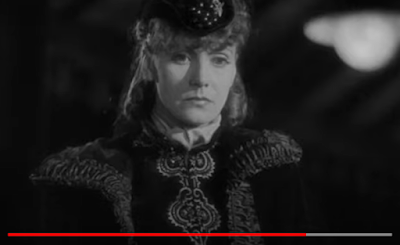
Yet it's Garbo background years in silent films when facial expressions did the work that spoken dialogue would later do. Greta Garbo, in "Anna Karenina," telegraphs every feeling which passes through her, and we see complex layers of understanding, emotion, and reaction. In this post, I've grabbed a series of stills from the train depot scene at the end of the movie so you can see what I mean. At the end of the post, I've included the full clip so after seeing the stills you watch the scene unfold. 


Anna has come to the train station to search out her lover, who is leaving on a troop transport with his fellow cavalry officers. She needs to let him know that she does plan to leave her husband and devote herself to a new life with the man she loves. 


She's spotted him, but he's not alone. He's flirting with a younger woman, and it's obvious that his former flaming passion for Anna is now a thing of the past. 


The three women walking by don't see Anna. The woman in the middle is the new younger love interest, and the woman at her left, with the black gloves, is Anna's lover's mother, who has engineered Anna out and the younger woman in. 


Garbo was only 29 when she was filming "Anna Karenina," but the severe braided hairstyle and this strategic head turn make her appear older. Time, and scheming match-making matron, have bested beauty and charm. And she can't go back to her husband and son, either. Anna's done for. 


Well, here are some convenient railroad tracks. 


Is there anything else she can do? She can't think of anything. 


Well, she's not going to pretend like she doesn't know how cold life has become in the last hour. 


Now she must wait till the train station empties so no one will try to stop her. 


She's thinking of her son, I imagine. 


But no matter what she does now, she won't see her son. There's nothing else left. 


She takes in a big breath so she can exhale and do what she's determined to do. 


She has to rush into it, before she loses her nerve. She's so frightened. 


Anna Karenina, totally alone, detaches from life itself. In a moment, she'll disappear from our view.


She's gone and no one hears or sees. 


The train schedule continues. The caboose is pulled along and will vanish into an unseen future, where people will get on and off the train cars, unaware that someone departed from the station platform. 


Now that you've seen this part of the story in a few screen captures, here it is as it was shown in movie theaters in 1935.


Note: This is the second time Greta Garbo played this Tolstoy character; there was a silent version given the title "Love" to capitalize on the Hollywood-built romance between Greta Garbo and John Gilbert. 


Next week:  Part 2 -- How did Anna get into this awful situation?


Garbo

Monday, November 8, 2021

Twenty From 1971

 by whiteray

I saw a squib the other day on Facebook for a book titled Never a Dull Moment: 1971, The Year That Rock Exploded by writer and broadcaster David Hepworth, a book that’s now waiting on my to-read pile. The squib was followed by a challenge to list the twenty best albums from that admittedly very rich year. I find that kind of thing irresistible. 

So, here – in no particular order – are my twenty favorite albums from 1971, which was, in fact, a great year for music. The greatest? Impossible to say, except to note that it lies right in the middle of my sweet spot. The years of high school and early college – 1968 through 1974 – were the best years for music for me. 

I should note that one album that I wrestled with was the star-studded live album The Concert For Bangla Desh (organized by George Harrison and Ravi Shankar and featuring Eric Clapton, Bob Dylan, Ringo Starr and more) but I decided that all-star live albums have an unfair advantage. I’ll just note that Leon Russell’s “Jumpin’ Jack Flash/Youngblood” medley at that concert might be the single best thing released in 1971. 

Beyond that, I’ll just say that on another day, this could easily have been a very different list. There were at least ten other albums that could have made the list without any angst on my part. 

Tapestry by Carole King
Sticky Fingers by the Rolling Stones
It Ain’t Easy by Long John Baldry
Naturally by J.J. Cale
The North Star Grassman and the Ravens by Sandy Denny
Madman Across The Water by Elton John
Pearl by Janis Joplin
Ram by Paul & Linda McCartney
Mudlark by Leo Kottke
Every Good Boy Deserves Favour by the Moody Blues
Stargazer by Shelagh McDonald
Leon Russell & The Shelter People
Stoney End by Barbra Streisand
Teaser & The Firecat by Cat Stevens
Every Picture Tells A Story by Rod Stewart
The Low Spark Of High Heeled Boys by Traffic
Just An Old Fashioned Love Song by Paul Williams
2 Years On by the Bee Gees
Chase (Self-Titled)
Closer To The Ground by Joy Of Cooking 

I didn’t know all of these in 1971, though most came to me during the decade of the 1970s. Those I knew in 1971 – whether through my record collection, or my sisters, or those of friends’ – were Tapestry, Pearl, Ram, Mudlark, and Teaser & The Firecat. The folks hanging around in the lounge at St. Cloud State’s radio station early in 1971 liked to cue up Long John Baldry’s “Don’t Try To Lay No Boogie-Woogie On The King Of Rock & Roll” along with the shaggy dog story that preceded it; we’d laugh at the tale and the nod our heads to the music coming from Studio B as the faculty-mandated classical music went out over the air from Studio A. But it was years before I heard Baldry’s full album. 

By the end of the Seventies, most of those albums had found places on my shelves. Two of them – the albums by Sandy Denny and Joy of Cooking – didn’t come home with me until sometime in the Nineties, during the time that I was living within half a mile of a used record store and was bandaging the hurts of life with regular purchases of LPs. (There are, to be sure, worse addictions.) 

And two of the albums among my twenty best of 1971 were off my radar until after the century changed. Even though I’d liked Barbra Streisand’s single “Stoney End” when it popped out of radio speakers in 1971, I’d ignored the album until sometime in 2016, when my external hard drive died and I found myself trying to rebuild the vast collection of mp3s that I’d lost. One of them was the track “Stoney End,” and by chance, I found the CD listed online at a ridiculously low price. I bit and learned I liked the rest of the stuff on the album too. 

The other album that came to me in this century is Stargazer by Shelagh McDonald. Sometime around 2005, I discovered her story. The owner of an achingly lovely voice, the Scottish folk singer, songwriter and guitarist had released two albums and was on the edge of stardom in Britain when she simply disappeared in 1971. When her music was released on CD in 2005, piquing interest in her, she showed up one day in the offices of the Scottish Daily Mail and told her tale. Wary of being swallowed up by both life in London and by the music-making machine, she’d gone off with her boyfriend to live the gypsy life in a caravan – called in the States a camper – in quiet corners of Scotland. She’s since supposed to have released new music, but I haven’t been able to track it down. 

So which album from those twenty is the best of the best? The most successful commercially and critically – as judged by sales and awards – is Tapestry, and that’s probably a good choice. (A blogging friend of mine wrote once that the piano figure that open the album’s best-known track, “It’s Too Late,” is the sound of the summer of 1971 distilled to seven seconds.) 

But sales and awards aren’t everything? How about death? Bill Chase – leader of the group that took his name and released a self-titled album in 1971 – died along with several members of his band in a 1974 plane crash in my home state of Minnesota. Sandy Denny died in 1978 in suburban London after several falls. And of course, Janis Joplin died in September 1970 of a drug overdose. 

Well, sales, awards, or death may make an album famous or notorious, but of course they add nothing to the quality of the work. And I can’t really say which of those twenty albums is better than all the others. Their value to me shifts like the phases of the moon, waxing and waning so that one of those albums fits my mood perfectly on, say, one Monday morning as I take care of laundry while on another day, I find no joy in it. Another of those twenty might fit a bleak midnight mood one week and be utterly unsatisfying the next time a similar mood passes through. 

If forced to choose, well, I wrote some time ago that of all of life’s flavors, I tend to default to bittersweet. And there is no album that among those twenty that offers more of that flavor than the relatively neglected Paul Williams album, Just An Old Fashioned Love Song. It was the diminutive singer-songwriter’s first album to hit the Billboard 200, topping out at a less-then-stellar No. 141, and its lead single, “Waking Up Alone,” was Williams’ highest charting single, reaching No. 60 on the Hot 100 and No. 19 on the Easy Listening chart. It would be my favorite of those twenty listed. 

And the single “Waking Up Alone” is my favorite track from the album. Here it is:

Sunday, November 7, 2021

Florida, Oddly Enough

Roadside studio in Cleveland, SC

I chose a random photo from my camera roll this week, as a writing prompt. I had to think about it, see what it suggested to me. It made me think of a character, who found a nice piece of wood one day. Perhaps he carried it home from the woods, or loaded it into his old truck. He lined it up out back with some other nice logs he'd found. Oak, cedar, even some magnolia. He'd have coffee and mull over the pieces, wondering what was inside that he could bring out. A bear, a cobra, a cockatoo? It can sometimes take a week before he sees what  is inside the wood.
He can take his time because he doesn't have a regular job. He lives and works in his studio, and sells under an awning in the front yard, which has a wide swath of gravel across it. Cars can easily pull in from the two lane highway that will take them from Greenville and Traveler's Rest, to Paris Mountain and up toward Asheville, NC. Passersby are his main clientele. His bills are paid, his food easily gotten, his wants and needs few because he loves what he does, and the place where he lives.
One time he made a pig from some twisted cedar. A small but round pig, a pink and orange runt. Like Wilbur, in Charlotte's Web, his daughter's favorite book when she was young. He hadn't had that pig out for a day when a young woman and her son got out of their car to look at it. "My son loves pigs. We are in a pig loving phase." she says. She's visiting the area, and was originally from Greenville, but doesn't have much family there anymore. She remarks how it is the most fragrant part of the country she has ever known, and how nice and cool the evenings were in summer even if it had been a hot day. She wonders if it is still that way. The man notices how the boy gently pats the pig, as if were a round, warm, living creature. This is why he never puts prices on his work. He watches the boy. Pieces can bring from fifty to four hundred dollars. People love those big bears.
He wants the boy to have the pig. He tells the woman twenty dollars and she says she can't believe it! "Thank you! It's worth more than twenty!"
You watch her walk away, the cedar pig tucked under her arm, the boy squealing, "Oh, my pig, my pig!" as he climbs in the car. He turns and grins and waves, she does too, as they drive away.
Later he calls his daughter to tell her the story of the pig and the boy.

~Dorothy Dolores