As a young person, one of the most difficult things for me to accept in art was very deep abstraction. I didn’t get the point of abstraction as an end in itself, whether or not I wished to deny its validity within figurative visual art. Basically, I thought, it never did it for me; I never understood what it was for. I was looking at it the wrong way round.
If we define abstract art as the rejection of figurative or representational art then it’s probably going to be quite dull. A better way to look at it perhaps is to say it’s not attempting the figurative, but rather uses shape, line & colour to realise an outcome, solve a problem or make a point. When we view something we quickly recognise, it can be comforting & because we understand it, we remain in that zone. But we need to be challenged. Always. Except for validation, what’s the use of something that tells us what we already know? Narrative art is one thing but isn’t it just as stimulating to look beneath the surface in all forms of creativity: literature, music, dance, drama? Explore the symbolism? Learn something about the world? About ourselves…? To be made to think?
Abstraction progressed all movements, that could actually enhance more figurative works, indeed I’m now able to see it as a vital point in the evolution of art history. Everyone has to find their way & some of the greatest artists have done so via abstraction. Don’t get me wrong - as usual, there are still works I dislike intensely, but that’s not helpful. What are the abstract works we like? What are the ones that give us a greater understanding of what abstraction is about? Or what the world is about? I’ve cobbled together my own small list…
Hilma af Klint (1862-1944), Sweden
The Ten Biggest, No 2 (1907)
Not only was the first abstract artist a lesser-known painter, but she was a woman. There was a time when the argument about who had painted the first abstract picture raged but Klint predated all the frontrunners & big hitters of the time. One can assume it would have been a highly lucrative first place. Unusually for the time, Sweden allowed women to study art & Klint graduated from the Royal Academy of Fine Arts in Stockholm, subsequently working for the veterinary institute. She came to abstraction via theosophy. Following The Ten Biggest series, she began working with more geometric forms, but never exhibited any of her abstract pieces in her own lifetime.
Wassily Kandinsky (1866-1944), Russia
Cossacks (1910-11)
Kandinsky was one of the artists keen to go down in history as the first abstract painter, claiming to have painted a lost piece that dated back to 1911. Of course he knew nothing of Klint at this point, but even so, she had done it before him. Similarly though, he too felt painting in this way brought him closer to a spiritual truth. He was interested in the way art could represent feeling through the composition of colour & line. Although the Cossacks of the title can be seen by their hats as little orange squares, the only other realistic forms might be of roads or buildings. The marching Cossacks in fact cause us to try to make sense of these other brushstrokes.
Abdülkadir Şükri Efendi (1806), ?
Hilye-I Şerif (18th Century)
Then again, was Klint the first abstract artist really? After all, different cultures had been mark-making to describe reality in visual forms for centuries. I suppose here it boils down to purpose & intent. In Islamic culture of course, realistic depictions of the prophet Mohammed, other humans & animals are for instance forbidden. Here calligraphy is used to express Mohammed’s physical form.
James McNeill Whistler (1834-1903), USA
Nocturne in Black & Gold: The Falling Rocket (1874)
Okay, it’s not 100% abstraction, which is probably why I’m so keen, but here Whistler is challenging what art & paint can do. Only the title gives us the real clue. & Whistler being Whistler, he sued art critic John Ruskin for libel when he accused the artist of effectively throwing paint at his audience. Good for Whistler I say. Although he won the case against Ruskin, it bankrupted him. Nevertheless his cross-examination is worth a read on his wiki – it ends with Whistler justifying the cost of the painting as being “for the knowledge I have gained in the work of a lifetime,” an argument artists of all kinds sadly still have to make to this day.
Albert Gleizes (1881-1953), France
Les Arbres (1910-12)
I often find myself drawn towards abstract art with a more muted palette, in the style of Cubists like Braque or Léger. Les Arbres leans towards the Cubist style but for me, it’s the title that places it in the Abstract category.
Theo van Doesburg (1883-1931), Netherlands
Composition in Gray (Rag Time) (1919)
From the Neoplasticism (or De Stijl) school of art theory, van Doesburg has created a work that does not appear to represent the title whatsoever but maybe because we are of this century, we tend to accept it. We suppose, yes we could see the possibility of the music or a dance being represented by the order & organisation of the shapes. He too concluded that abstraction was the next logical step in the development of higher thinking & perhaps spirituality within painting.
Each superfluous line, each wrongly placed line, any colour placed without veneration or care, can spoil everything—that is, the spiritual.
Barbara Kasten (1936-), USA
Scene III (2012)
Of course, after a certain point many artists working with photography have brought new possibilities & a range of different challenges to the genre. Scene III recalls Cubism as well as including the effects & ethereal qualities theatre strives for in the composition as well as the title. It shows understanding of & maximises the use of light, shade & reflection.
Ruariadh O’Connell (1983-), Scotland
The Pursuit (2019)
From Aberdeen! O’Connell reminds us of the work of Op Artist Bridget Riley in this piece in resin & jesmonite.
Tariku Shiferaw (1983), Ethiopia/USA
Cranes in the Sky (Solange) (2020)
I was very taken with this piece when I found it but this artist interview is worth more of a read than anything I’d put down in a few words:
There is of course a difference between stylisation & abstraction. Whereas Henry Moore & Barbara Hepworth did create works that resembled nothing recognisable, they also abstracted human figures by deconstructing them & boiling them down to very basic shapes. Here however, we only know these are people from the title & when we know the context, we accept it. This is what I missed as a young person - the transformative magic of abstract art.
Another
week to remind me that groans and complaints about things already
tasking me only seems to invite new ones, while doing nothing to alleviate the old. I've made it to another Friday
feeling not only drained and behind schedule, but keeping my ear cocked
for the phone, part of a chain of likely expensive bits of news and
decision(s) to make. But hey, that's life. Now, to escape it in
controlled packets.
A quick aside: One of the viewing highlights for this week was episode 9 of season 3 of Doom Patrol over on HBO Max. I've lauded the series before, and recent weeks have only reinforced that for me. This season's turns as they've been dealing not only with their manifold personal problems, but contending with the Sisterhood of Dada, coming through the weaponized art of The Eternal Flagellation with several members seemingly healed into action irrelevance, and now the return (though new to nearly all there) Brotherhood of Evil, have been gloriously entertaining. Wild fun. The snippy domestic friction between the Brain and hirsute housemate Monsieur Mallah, the latter peeved that this revival of Brotherhood nonsense is disrupting the tranquility of their long retirement in Boca Raton, remains one of several scenes I'm already anxious to revisit. Next week will wrap season three, and season four will be too long in coming. Recently finally got around to
watching and enjoyed the 10-episode comedy-drama (is "dramedy" now a
passe' term, or been tagged as something more distinct? What are the
young people and the cognoscenti saying these days?) on HBO Max: Hacks.
Starring Jean Smart and Hannah Einbinder, respectively as a legendary
comedy diva who has been largely in a Vegas cocoon of fans who've
happily kept her insulating from adapting to the times, and as a 25
year-old comedy writer whose first blush with success was derailed by an
"insensitive" tweet she made, which cost her her job and helped make
her a professional pariah. A mutual agent lines up the two in the hopes
of fixing two problems, even though the first isn't looking for a
writer, much less an update of material, and the latter really doesn't
want this job. It's
a fun, occasionally thoughtful trans-generational and -cultural clash.
If there's a core message it's that we all tend to form largely
dismissive opinions of others, and that's a character and operational
flaw we'd be wise to correct. Most meaningful growth, at least as
adults, involves discomfort. Most of the messages in Hacks are
cautionary tales about the need for (negative) impulse control. I'd
have moved through it even more quickly than I did once I tried it,
were it not for my schedule and deciding I didn't want to rush it. The
series ran from mid-May through June this year, and was renewed for a
second season back in June. So, if you have HBO Max, add it to the list
of items to get around to, and if you don't, add it to the list of
reasons to consider trying the service (which has a huge inventory) in
the months ahead. The next series I want to mention
is one that reminds me how once strong entertainment appetites can be
overwhelmed by formula and sheer, repetitive volume, all the more
rapidly as lesser talents get involved. I can still remember when zombie
apocalypse was a relatively small, sub-genre, decided off the
mainstream, existing almost exclusively on the big screen. Jump ahead to
2021, and Kirkman's adaptation of comics' The Walking Dead has
not only been on the air for 11 years and spawned two spin-offs, but I
wandered away from it during a mid-season hiatus a solid three seasons
back. In this age of aggregating, streaming content such things have
become like reading material -- things to often be stacked-up for
binge-attention at some later, somehow more appropriate time. They're
not pressing, as we have this sense of "having" them. So it was that I was almost surprised at myself when I set DVR pre-sets to record a new, Syfy series Day of the Dead,
which started back in mid-October. Friday nights at 10 (Eastern),
tonight will be the fourth episode. It momentarily seemed odd that I was
open for this, when I'd left so many familiar characters behind in this
genre halfway through their war with Negan back in season 8 of The Walking Dead. While
there's a little more to it, I realized it's mostly two things: First,
the new series offers what I'll luridly reference as "zombie porn,"
which is most decidedly not a reference to any nudity or sexual
material, but rather just to one of the hooks of the genre: We get to
see new characters facing the new and unbelievable to them - the
beginnings of this rising of the dead. It's made loosely novel again via
the surrogates.
Second,
as it's a Syfy series I'm never sure where and when it's going to land
as streaming content -- eventually, most likely it'll be Netflix, but it
could be a looooong wait -- where I'll be able to watch it sans
commercials. It's at the stage of currency where having the DVR catch
it, so I can watch it when I want and do Hulk-like, 30 second leaps
through the commercial breaks with the press of a well-worn button, is
optimal. The downside is that my Fios DVR service has storage limits, so
there's more of a press to watch items there so I can delete them and
free up space for upcoming shows and movies. So it is that often lesser items get a faster viewing track than better material that's in a more stable location. Anyway,
this new series is still at an early enough stage that we don't know
the exact mechanism nor all the rules. The reanimated dead here are more
Romeroesque in general slowness (much as those of The Walking Dead),
though we're still working out whether or not being bitten is a death
sentence, and the usual head-shot solution isn't a remedy here. There
are also elements of the very non-Romero, zombie sub-genres where
whatever contamination or force that's reanimating corpses is also
affecting the long-buried, so the local cemetery is suddenly busting out
with corpses (some of whom dies with pretty amazing sets of teeth, it
seems) erupting from the ground. Inexplicably, even parts of bodies are
seen to move with deliberation. Magic or silliness -- it's too soon to
tell. In a note reminiscent of one of the casual but repeated references in Jim Jarmusch's 2019 dark comedy zombie-fest The Dead Don't Die
(which I and son Nick enjoyed, but didn't seem to be a crowd-pleaser),
there seems to be a connection between local fracking operations and the
undead unrest, though it may not be as direct as simply new
contaminants.
Some
of the characters in this new series at least start off as cliches,
none so more than this small-town, rural Pennsylvania mayor, Paula
Bowman, who's cast in a role that would normally have been given to a
man: White, Conservative, pro-gun (and pro-open carry), mayor who is
tied to the town's contract with a fracking company, and otherwise tends
to sneer at the feelings of "snowflakes" while acting in service of
greater personal power and glory. She has a trophy husband whose looks
have meant he's never had to focus on developing his wit or intellect --
a nice guy, but used to being generally kept. So far Paula's
interesting mostly because she manages to walk the walk, as it were,
demonstrating a willingness to act decisively and forcefully despite
very possibly being the physically smallest character in the town. She's
played by Canadian actress/singer-songwriter Miranda Frigon, who's
under 5' 4". Anyway, there are other characters of
interest, which we get to spend much of the time with - younger (and
much older), more ethnically-diverse and simply likeable characters,
but not such that I'll spend the time on them here at this early stage.
(I'm already a little thrown that I've taken this much time with it.) As
with most Syfy fare I so far can't really recommend it, but I still
wanted to point it out while it's still relatively new, and episodes can
be streamed on Syfy's site and likely one's cable provider -- albeit
with commercials. If any of the above, and the trailer (in a moment)
combine to be of interest to you, you now know that it exists. My work
is done. I'll have much to highlight over on Disney+ as we roll through the month, but this week I'll just note that X-Men: First Class
(2011, 2h 12m) has joined the offerings there, where it may end up
remaining for all time. Part of the now-defunct Fox X-verse of films,
from their attempt to relaunch the franchise with new actors. It's all
owned by Disney now, so with the multiverse and all there's always the
possibility of some eventual, cameo call-backs. No special reason for me
to mention it, but it popped out at me while checking for newly-arrived
items at the streamers. Probably just impatience waiting for new Marvel
material while mostly ignoring The Eternals.
Hulu's gotten an infusion of new-to-them, old material as of the new month, too. Not generally much of a John Wayne fan, but a few of his that I've liked to watch are now in the mix here: True Grit (1969), The Quiet Man (1952 and horribly dated -- but worth it at least for the cross-country fist-fight, complete with pub break), and The Shootist (1976 1h 40m Wayne's final film role, and something that coincidentally I brought up in lab conversation earlier this week.)
Also in the Hulu mix is the George Pal-produced War of the Worlds
(1953 1h 25m), which is one of those films fondly remembered from
childhood. Sure, the ghastly 1950s U.S. socio-political atmosphere
infected it with ham-fisted, pro-religion touches that likely would have
gotten an apoplectic rise - or at least an overt series of eye rolls -
out of secularist H.G. Wells had he lived to see hear them. I know I
groan at a few spots. The last couple times I watched it I shut it off
while the Martians were still winning, or at least before the final
narration, so as to at least let it end on a more dignified note. Many,
many changes from the source novel as the human center of the tale was
relocated to the Pacific Coast, but the alien war vehicle redesigns,
including trading in the mechanical tripod design for ones with
invisible, electromagnetic ones, remains elegant. I'll want to check,
but I expect this is the hi-res, restored 2018 version that the
Criterion collection later put out, where they went back to the 3-strip
Technicolor originals, instead of the inferior Eastman Color stock
they'd been replaced by during the '60s, seeking to restore the visual
quality it originally wowed with. Paul Frees'
narration, including an on-screen turn as a broadcast correspondent, are
among my most fondly-remembered touches in the film.
Arriving on Hulu today is the second (new) season of the revival of Animaniacs.
I watched the first couple this morning -- each with a piece featuring
Wakko, Yakko and Dot, and another with Pinky & the Brain, and the
rapid-fire, frequently cutting humor is still there. At worst the
production lag resulted in more of an emphasis on Trump and even Brexit
in one piece set in ancient Rome, but, hey, it works, and unfortunately
it's not as if either of those real world debacles have gone away. Also newly-arrived (okay, yesterday) on Hulu is Playing God
(2021 1h 35m). A con artist team targets a grieving billionaire,
offering him a meet and greet with God. Despite a trailer that otherwise
seems to give the movie away, I'm still uncertain what to expect in
terms of a message, and I'm leery of digging for more info, not wanting
to give even more away. Alan Tudyk (grieving billionaire) and Michael
McKean (playing God) get me interested enough to risk potentially shoddy
plotting and an indecisive message. The two leads (Hannah Kasulka and
Luke Benward), playing the sister-brother con team are almost completely
unknown to me.
On Netflix, as I know at least one person who's a fan, I'll mention
that season 5 of the animated, raging hormone adolescence comedy series Big Mouth
landed today. A little of this goes a loooooong way for me -- I'm not
sure I've gotten out of season one yet. The subject matter's not a go-to
for me, and the line style succeeds a little too well for me in
conveying the unpleasantness of most people as sexual beings. Hey, I'm
at least owning my hang-ups. On Netflix since Wednesday is a new, made-for-Netflix, gangsta western The Harder They Fall. Interesting cast and possibilities. While
not strongly drawn in by the true crime genre, and particularly wary of
anything with an "inspired by true events" tag (the best one can hope
for is that it helped the writers think of a story worth telling),
Swedish production, The Unlikely Murderer, looks as if it could
be an interesting series. Based on events surrounding the 1986
assassination of Swedish prime minister Palme, and how inept police work
allowed the assassin to get away with it in nearly plain sight. The
total run time is 3h 48m.
Arriving today on Amazon Prime we have the intersection of Benedict Cumberbatch and Victorian era cats in The Electrical Life of Louis Wain
(2021 PG-13 1h 51m). A biopic focused on the ultimately tragic tale of
late 19th century artist Louis Wan, whose rise to prominence came
through his surreal cat paintings, which reflected his failing sanity.
The popularity of Wain's work is credited with popularizing cats as
house-pets, rather than simply keeping one around to deal with local
rodents. Co-written and directed by Will Sharpe, the film also stars
Clair Foy, Andrea Riseborough, and Toby Jones. I'm informed it even has a
brief appearance by Nick Cave, appearing as H.G. Wells.
I'm
looking forward to watching this, but at the same time I want to try to
line up something else, or a different, affirming activity, to follow
it up as I'm expecting it to leave me sad in the balance. It
would probably have been classier to close on that note, but this
Sunday. over on Showtime, we'll be seeing the return of serial killer
Dexter Morgan, who we last saw in a mute, dehumanized state back on
September 22, 2013, when the 96th episode of Dexter aired. Over eight years?! A
great deal of (former) fan ire's been unleashed on that series finale
over the years, in what I still see as an unfair focus. In reality, it
was most of that final season that was a problem, with the show having
gone fully off the rails well before the final episode, the audience's
credulity abused beyond all reason by how Dexter managed to remain free
and seemingly undetected. To only react to the final images of the
series as if those are the problem still strikes me as absurd. The final
few episodes had a clear arc, as the sociopathic Dexter had been
stripped, a piece at a time, of his support system, his near life-long
project of faking humanity till he might make it finally, fully
abandoned. The silencing of his inner monologue was just the final
deconstruction. We were just left uncertain with how temporary or final that state was to be. Anyway, starting Sunday we'll get to see where the intervening decade of survival adaptations has taken him as we see the start of Dexter: New Blood. Looking forward to it, including the full makeup of his new life. I'm particularly taken with how adoptive sister Deb has become his new, internal sounding board and general Jiminy Cricket virtual conscience, replacing adoptive father, Harry, who was banished as part of the late season eight deconstruction mentioned earlier. I can't be the only one looking on with interest. Any (former) fans with an opinion?
Continuing
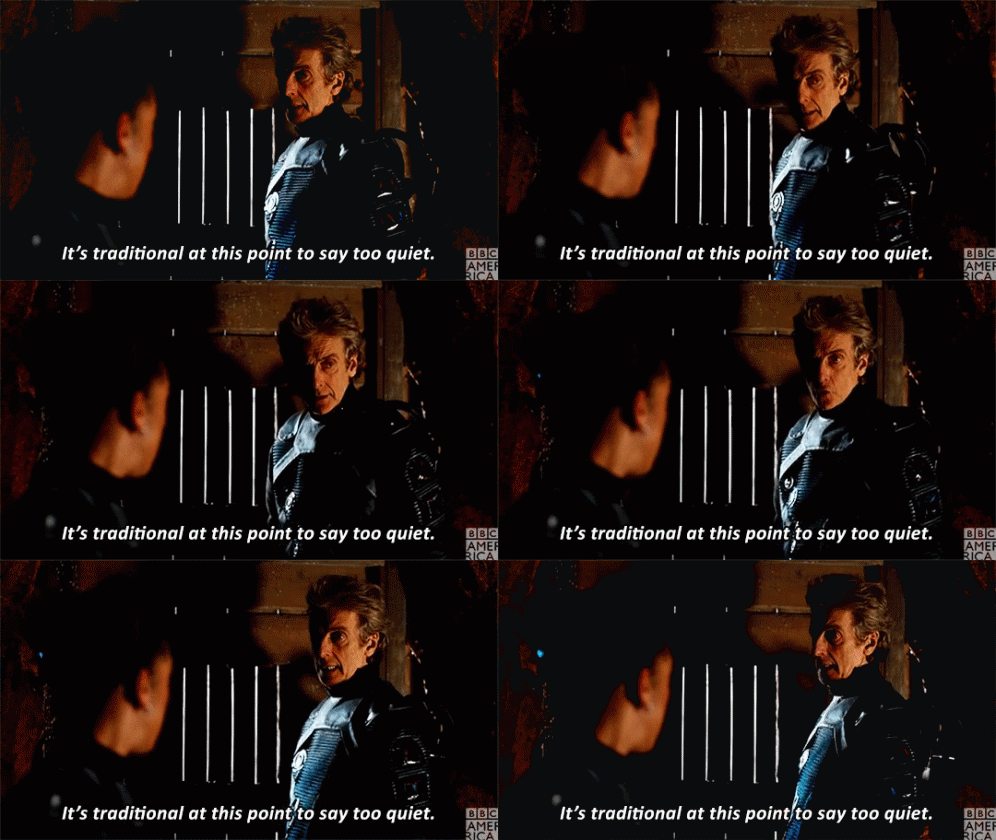
my Friday vigil for the first of the diagnostic calls concerning the car. (It's quiet. Too quiet.) I don't know how late I should let it go before calling for an update. Making arrangements for an almost certain transfer from one mechanic to another will only be part of it, and it's getting late on a Friday afternoon. Finding out what support they have with respect to a rental car will be another. Wish me luck in sorting things out. Ideally I'll be in
a much better state next week! Take care, and stay warm! - Mike
Happy Thursday, everyone! The sports year is over as the World Series ended last night so we have to wait until February for the return (OK, fine, there are plenty of other sports but my Bears are rebuilding, my hockey team is awfully sexist and racist and the Bulls look OK). But anyhoo, enough of my griping. This week we have some more effective schlock, a 1992 movie that should have gotten a lots more awards recognition and a boxed set of books that rewards my weird level of OCD.
______________________________________
Defending Your Life is going to be a revisit for me, in this case I think my first look since it came out in 1991. Since then I've aged, I've been married and divorced and married again and I'm very curious to see how this movie about a man who dies and ends up in an after-life waiting room where he has to, well, defend his life or go back to do better will pay with me. I fully appreciate that my fascination with this sort of narrative can be weird; I am an atheist who doesn't expect any sort of reevaluation after death, but this kind of narrative makes me understand just a little the appeal for those who do believe in this. And this movie is funny. Brooks, as always, is just plain selling on his neuroses, but it's Meryl Streep as his fellow dead person who keeps stealing this movie. She is amazing as a woman who was apparently so...great in life that she's sailing through her defense but she never seems a jerk about it. I'm fully convinced that her performance in this caught someone's eye and is why she plays the drug-addled, goofy version of the very real Susan Orlean in Adaptation a little over a decade later.
Defending Your Life is available for rent on the usual places and streaming on Cinemax.
Weirdly, Adaptation is not part of any streaming package. But it's only like 3 bucks and well worth your time.
______________________________________
I feel like Deep Cover is a weird movie that has somehow slipped between the cracks. Like, how does a movie where Laurence Fishburne and Jeff Goldblum, where one of them may be a deep cover police officer that has gotten in just way too deep, kind of disappear? This is a minor classic directed by Bill Duke...and hoo boy, if you only know Bill Duke as a character actor, let me dig in a bit here.
I always think of Bill Duke first in Predator, one of the finest action movies ever made. He's not the biggest part in the movie, but he has such a presence to him, including a point where he's shaving with a dry razor that breaks when he hears something out in the jungle. But Duke is also an excellent and long-standing TV and movies director, all the way back to Cagney and Lacey. Deep Cover might be his masterpiece, a movie that understands the weirdness of the subject and has a sympathy for it.
Deep Cover is streaming on HBO Max and Cinemax and available for rental on all the usual places.
_______________________________________
Richard Matheson might be one of my favorite speculative fiction authors. He wrote for The Twilight Zone (the classic one being him adapting himself for "Nightmare at 20,000 Feet"), he wrote for The Outer Limits, his work has been adapted all over the place in various ways. (Seriously, his novel I Am Legend has been adapted three times and the main character played by Vincent Price, Charlton Heston and Will Smith, which is some kind of good actor trifecta.)
But wow, this one...this one always comes back to me. The story of Scott Stuart, a man who goes through a mysterious cloud while sailing who then starts just...shrinking. And shrinking.
And shrinking.
This is one of those really interesting '50s movies that has a weird science fiction hook but also has something really interesting to say. What happens if you're a standard '50s normal white guy and you start getting smaller? Like, smaller than your wife? Smaller than a child? Smaller than a cat? What does that do to your Greatest Generation mind?
It's a weirdly sad movie with great effects that hold up much more than you might expect from 1958. Rear projection, of course, but hey he's fighting cats and spiders! People have talked about remakes over the years but unless someone finally cracks it like the incredible 2020 remake of The Invisible Man, please don't.
The Incredible Shrinking Man is at the usual places for rental as is streaming on Peacock.
___________________________________
And now...my find of the week.
Why yes, I'm the guy who wants the same box set of the Narnia books I had as a child.
The one with these weird covers.
With Aslan's head floating in the sky.
BUT MOST IMPORTANTLY WITH THE BOOKS IN THE CORRECT ORDER.
Backing up here, for a long time the Narnia books were ordered and numbered in the order of their publication, which meant that The Magicians Nephew ended up 6 out of the 7. At some point, the publishers decided to screw with that for no reason and re-ordered them for the internal chronology of the series, making Magician the first book in the series. It makes some sort of sense but it also doesn't, because the end of Magician leads directly into The Last Battle, both thematically and for plot reasons.
So yes, I'm the kind of crank who has opinions on how the Narnia books should be ordered.
______________________________________
This week's recent recommendation? David Cronenberg has a son, Brandon. Brandon Cronenberg made a movie. Andrea Riseborough stars in it. What, do I need to draw you a road map? (It's named Possessor and it's on Hulu and it's fantastic, one of the best movies of 2020.)
I've accumulated a few moderately vintage books over the years, and now need to figure out what use to make of them. None are the kind of thiung Goodwill has room for on the shelf. Therefore I have decided to utilize some of them for the Wednesday "Books & Authors" segments.
I'll begin with a 1924 edition of Emily Post's 627-page tome Etiquette.
My copy doesn't have a dust jacket.
This is the eleventh edition of Etiquette. I looked around online and found an image of the dust cover for the twelfth edition of the "Blue Book."
The first edition of Emily Post's famous book was published in 1922. I see from the lengthy list on the copyright page that Etiquette was wildly popular in the 1920s. Etiquette went through multiple printings in just those couple of years.
The combination of soft old paper and fading old ink make the page scans a bit of a challenges, so I've included a couple of highlights after each image.
"For a wedding anniversary celebration the year of the wedding and the present year are usually stamped across the top of the invitation."
"Capitals R.S.V.P. are permissible, but fastidious people prefer 'R.s.v.p.'"
Suggestion for wording a letter which includes an invitation: "Of course everything is always so beautifully done at everything you give, I wonder I have the courage to ask you to dine with me."
Post also has some ideas about what to write in a letter, to whom, and why:
"Admonitions from parents to their children may very properly be put on paper -- they are meant to endure, and be remembered."
Over the years, sales of Etiquette have slowed. Did Miss Manners de-throne Emily Post? Are fancy manners for fancy folks, and we no longer have a middle class aspiring to move up socially? Do we just live in The New Age of Rudeness? I'm not sure. But though there will never be the flurry of re-printings the book had in the years 1922 to 1924, there is still demand for Etiquette. The seventeenth edition was published in 2004, the eighteenth in 2011, and the nineteenth came out in 2017. I'm assuming there with be a twentieth edition next year, since 2022 will be the hundredth anniversary of the first edition.
When this series of blog posts about Greta Garbo's films began, the plan was to simply march forward through time and go film by film, Well, that hasn't quite happened, but after spending some time looking at various aspects of "Queen Christina," released in 1933, it's time to take on the 1934 film "The Painted Veil." Alas, this flick (remade in the early 2000s with Naomi Watts in the Garbo role) is not very interesting. In Year 2 of this blog I did write this post about the sources of Garbo's sound films and this overview of the themes and plot.
So today, here's a clip from the movie with Garbo in her famous white turban, as her character and her film husband watch a pretty amazing Asian dance production
The "Painted Veil" costumes are very high-style Hollywood, and a Garbo fan made this tribute video featuring the costumes the actress wears in the role of Katrin:
Had enough of "The Painted Veil"? Yeah, me too. So I'll fill out this post with a bit about Greta Garbo's ambivalence about movie stardom. By the time she was in her early 20s, Greta Garbo had already been through five years of having head shots taken to promote her beauty. The photos below show Garbo at around ages eighteen and nineteen.
Greta Garbo grew up in an apartment in Stockholm, the Swedish port city, in a poor family made poorer when her father died. As a teen, Garbo took work in a shop modeling clothes for potential buyers, then appeared in early filmed clothing-store advertisements. From there, she was talent scouted and began her career in German-language silent films.
Garbo lived in Berlin hotels while she became a star in Europe, then she traveled to Los Angeles. Startiug at the steamship dock, she posed for various "European film star comes to Hollywood" shots.
The Swedish starlet took up residence in the fancy Miramar Hotel on Wilshire Boulevard in Los Angeles. She made a number of publicity appearances for MGM, where she'd signed a contract and had her photo taken with the baby version of Leo the Lion.
As soon as the young actress entered the Hollywood star-making machine, she was put on a diet, had her teeth capped, and endured having her ankles and calves massaged to make them more shapely. A few months in, Garbo had already begun wondering if it was all worth it and considered going back go Sweden. She went back at least once to "visit family," but then returned to the U.S.
European movie star Greta Garbo:
American movie star Greta Garbo:
But then part of Garbo loved the admiration, and it must have felt great to be told how gorgeous you are and how lovely you look as photographers arrange you to thrill your admiring audience.
Cecil Beaton loved to photograph Garbo, and though she'd had her photograph taken thousands of times, she was ready to pose for Beaton. They had a difficult complicated personal relationship, and yet to my mind Beaton could capture some of what I think was the real Garbo. By the early 1940s, Hollywood was done with Garbo, and she was done with it, and yet the movie star portraits were important to her or she wouldn't have posed for them.
To finish up today's post, here's a YouTube video of a Garbo screen test.
Next week: "Anna Karenina"
Some of the photos in this post came from the wonderful website Garbo Forever. And the sign-off photo I use each week is one of Cecil Beaton's portraits.
As I wander through the forest of mp3s that has grown on my
external hard drive, I sometimes find it hard to see the trees. Trying to
decide on a single tune or title as a subject for writing is difficult when
there are more than 80,000 recordings covering the digital hills and valleys.
So, I devise ways to sort the lumber into segments that help
me make some sense of it. One of them – by year – is obvious and frequently
used. (The total of mp3s from my favorite year, 1970, now stands at about 4,300.)
So is sorting by title, which I use when I am considering writing about cover
versions of a song. And a while back, I had the RealPlayer sort all 80,000-plus
mp3s by title, and the results pointed something out to me that I kind of knew
but hadn’t really thought about, if that makes any kind of sense.
I like songs about Memphis, Tennessee.
A rough count this morning showed that I have more than ninety
recordings of songs with “Memphis” in the title. That total is vague because
I’m not sure if I should count the six versions of Bob Dylan’s “Stuck
Inside of Mobile With the Memphis Blues Again,” as it’s not really about
Memphis, unless it’s a Memphis from an alternate universe. Nearly ninety
recordings, however, are about the real Memphis, the home of rock ’n’ roll that
was the gateway out of the South for millions during the Great Migration of the
mid-Twentieth Century.
More than any other large city in the U.S., Memphis calls to
me. Someday, I hope, the city will be a gateway for me into the South, as I
still have hopes of getting there and then heading south into the Delta to
explore a territory that already seems familiar in daydreams and reverie. I’d
spend time in Memphis, too, of course, absorbing what I could of that city’s
history from the Stax Museum to the Lorraine Motel, from Graceland to the
famous ducks at the Peabody.
Given the southward pull I feel, it’s no wonder, I guess,
that I collect songs with the city’s name in their titles. The earliest
recorded such tune I have is Bessie Smith’s 1926 recording, “Jazzbo Brown From
Memphis Town,” and the most recent is “Memphis Train” by Melissa Etheridge,
which was released in 2016.
It’s easy enough to fill in the intervening decades: From 1934,
we have “Memphis Shakedown” by the Memphis Jug Band. In 1942, we find “Night
Train To Memphis” by Roy Acuff &
His Smoky Mountain Boys. In 1959, Chuck Berry offers us “Memphis,
Tennessee,” and the 1960s were thick with songs that were in one way or another
about the city atop the Mississippi bluffs: A couple of favorites are 1968’s “Memphis
Train” by Rufus Thomas and “L.A., Memphis & Tyler, Texas” by Dale Hawkins
in 1969.
The 1970s bring us, among others, Dan Penn’s “Raining In
Memphis” and Mott the Hoople’s “All the Way From Memphis,” both from 1973. In 1981,
Jesse Winchester gave us “Talk Memphis,” while John Fogerty’s 1985 track called
Elvis Presley the “Big Train (From Memphis)” and John Hiatt released “Memphis
in the Meantime” in 1987.
And the early years of the 1990s were chock-full of Memphian
melodies, starting with the obvious, Marc Cohn’s brilliant “Walking in
Memphis.” Also released between 1991 and 1994 – during the early years of that
decade’s revival of country music, I’d say – were “Maybe It Was Memphis” by Pam
Tillis, “Wrong Side of Memphis” by Trisha Yearwood, “Memphis Pearl” by Lucinda
Williams and “Memphis Women and Chicken,” written by the previously mentioned Dan
Penn with Donnie Fritts and Gary Nicholson.
Penn’s performance of the song, from 1991’s Do Right Man, is good, but the first
version of the tune I ever heard was by T. Graham Brown, who covered “Memphis
Women and Chicken” on his 1998 album Wine
Into Water and made you smell the perfume and taste the grease. (That was
also the year, as it happened, that The Band covered Bobby Charles’ “Last Train
to Memphis” on Jubilation, the group’s final release of new music.) And
Alvin Youngblood Hart went “Back to Memphis” in 2000.
In the first two decades of this century, songs about
Memphis continued to show up: The Hillbilly Voodoo Dolls released “West Memphis
Three” in 2001 (which maybe shouldn’t count, as West Memphis is actually across
the Mississippi River in Arkansas), Etta James sang of the “Wayward Saints of
Memphis” in 2003, and Old Crow Medicine Show released “Memphis Motel” in 2008.
Two years later, in 2010, Rory Block included “Back to
Memphis” on her album Keepin’ Outta Trouble: A Tribute To Bukka White,
and Melissa Etheridge recorded “Memphis Train” as the title track of her 2016 album
Memphis Rock and Soul.
It’s hard to choose a favorite out of all of those, but if I
have to, I’m going with Etta James’ “Wayward Saints of Memphis.” It’s from her
2003 album “Let’s Roll.”